GEO vs SEO: What Changes, What Stays the Same, and What to Do
SEO gets your pages ranked, GEO gets your brand named in AI answers. They share a foundation and differ on the unit, the territory, the number of slots and the way you measure.
Published · Updated · 11 min read
Contents
- What is the difference between GEO and SEO?
- What stays the same between GEO and SEO?
- What changes with GEO?
- GEO vs SEO: how do they compare point by point?
- Does ranking well on Google mean being cited by AI?
- Is SEO traffic being replaced by AI?
- Which SEO habits do not carry over to GEO?
- Does the GEO vs SEO balance depend on your industry?
- How should you split effort between SEO and GEO?
- How do you measure SEO and GEO?
- FAQ
GEO vs SEO is the question I get most from founders right now: do I need a new strategy for ChatGPT and Gemini, or is my SEO enough? The short version is that they share most of their foundation and differ on what you measure and where you work. Getting this right matters, because AI answers already take clicks away from classic results: Pew Research Center measured 8% of visits with a click on a traditional result when Google showed an AI summary, against 15% without.
I ran an SEO agency with more than 100 clients before building Sorank, a platform that tracks how ChatGPT, Gemini, Perplexity, Claude and Grok talk about brands. This comparison uses public documentation from Google and OpenAI, the research paper that defined GEO, and the 498,158 AI answers Sorank collected between August 2025 and October 2026 (public on sorank.com/data, snapshot of 2 November 2026).
What is the difference between GEO and SEO?
SEO (search engine optimization) aims to rank your pages in a list of links. GEO (generative engine optimization) aims to get your brand named and your pages cited inside an answer written by an AI. SEO works on pages and positions; GEO works on a brand across your site and the third-party sources the AI trusts, and it is measured with mention and citation rates.
The term GEO comes from a 2023 paper by Pranjal Aggarwal and colleagues from Princeton and partners, accepted at KDD 2024 (arXiv 2311.09735). They defined it as a framework to help content creators improve their visibility in generative engine responses, and reported gains of up to 40%. Sorank's glossary entry on GEO gives the one-line definition. You will also see AEO (answer engine optimization), which I treat in a separate guide.
What stays the same between GEO and SEO?
The foundation: being crawlable, indexed, technically clean and genuinely useful. Most AI assistants answer business questions by running a web search and reading the results, so a page that is not in the index cannot be cited. Google says so directly about its own AI features:
"There are no additional requirements to appear in AI Overviews or AI Mode, nor other special optimizations necessary."Google Search Central, AI features and your website (developers.google.com)
The same page adds that to be shown as a supporting link, a page "must be indexed and eligible to be shown in Google Search with a snippet". On OpenAI's side, ChatGPT search relies on its OAI-SearchBot crawler: block it and you cannot appear (OpenAI, overview of crawlers).
So the parts of SEO that make a site reachable and credible are not "old SEO" to drop. They are the entry ticket for both. When a company tells me it wants to "do GEO" but its pages are blocked, slow, or rendered only in JavaScript, I send it back to the basics first.
What changes with GEO?
Four things change: the unit, the territory, the number of slots and the stability. Each one changes what you work on day to day.
- The unit is the brand, not the page. An AI answer names companies and backs them with links. Those links are often not your site.
- The territory is outside your site. On business questions, the most cited domains are review platforms, official sites, Wikipedia and directories. Trustpilot leads with 2.56 citations per 100 answers.
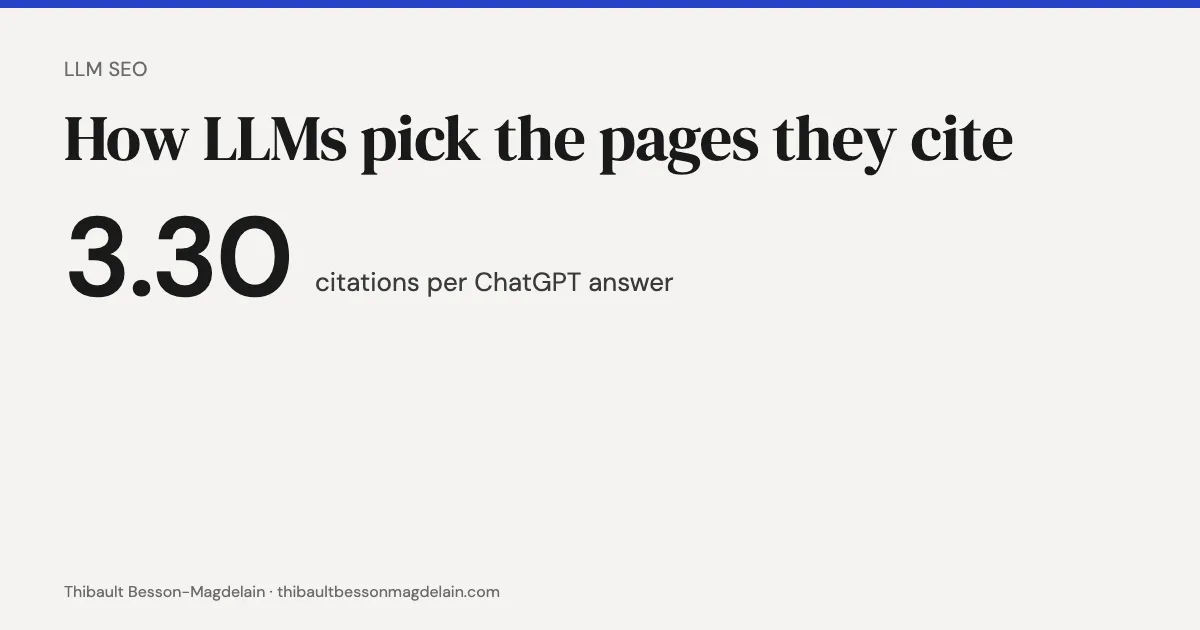
- There are fewer slots. ChatGPT gives 3.30 citations per answer on average, Perplexity 2.74. A results page shows ten blue links; an AI answer often shows three.
- There is no stable position. SparkToro's study of 2,961 runs found "a <1 in 100 chance" that ChatGPT or Google's AI gives the same list of brands in two responses (SparkToro, January 2026). You measure a frequency, not a rank.
The chart shows where GEO work happens. The ten most cited domains are official sites, directories, a review platform, big platforms, an encyclopedia and a video site. None is a brand's own website. For SEO, your site is the asset. For GEO, your site is one asset among several, and the others belong to someone else. I detail the full source ranking in which sources AI cites.
GEO vs SEO: how do they compare point by point?
Here is the comparison I use with teams. The left column is not obsolete: the right column assumes it is done.
| SEO | GEO | |
|---|---|---|
| Goal | Rank pages in search results | Be named and cited in AI answers |
| Where it shows | Google, Bing results pages | ChatGPT, Gemini, Perplexity, Claude, Grok, Google AI Overviews and AI Mode |
| Unit | Page and keyword | Brand and question (prompt) |
| Main assets | Your website | Your website plus reviews, directories, encyclopedic pages, media |
| Content style | Covers a topic for a keyword | Self-contained passages that answer one question each |
| Slots | About ten organic links per page | A few citations per answer (3.30 for ChatGPT, 9.21 for Gemini) |
| Stability | Positions move gradually | Answers vary from one run to the next |
| Main metrics | Positions, impressions, clicks | Mention rate, citation rate, share of voice |
| Tools | Search Console, rank trackers | Prompt panels run repeatedly across several AIs |
| Shared base | Crawl access, indexing, technical health, useful content, authority | |
Does ranking well on Google mean being cited by AI?
It helps, but it is not enough. Ranking makes your page eligible and visible to the retrieval step. Whether the AI then names you depends on whether your passage answers the question directly, and on whether third-party sources confirm you.
The models do not even agree with each other. In the Sorank data, only Trustpilot sits in the top 10 of all five AIs, and ChatGPT and Claude share a single domain in their top 10. ChatGPT's top three are service-public.gouv.fr (5.98 citations per 100 answers), Wikipedia (5.38) and economie.gouv.fr (4.30). Claude's are pagesjaunes.fr (3.33), sortlist.fr (1.65) and TripAdvisor (0.93). Gemini, built by Google, has yet another trio: Trustpilot (4.31), YouTube (4.02) and pagesjaunes.fr (3.45). A single Google ranking cannot explain both. My conclusion: keep ranking, and check each AI separately.
Is SEO traffic being replaced by AI?
Partly replaced, mostly redistributed. People still search on Google, but more of them read an AI summary and stop there, and more of them ask an assistant directly. In France, 48% of the population uses generative AI according to the Arcep digital barometer, and information search is the first use (73% of users).
My view, after years running SEO for clients: the companies that lose are not the ones "doing SEO instead of GEO". They are the ones who measure only clicks and do not see that they disappeared from the answer. If you still rank but your traffic falls, check whether an AI summary now answers the query, and whether it names you.
Which SEO habits do not carry over to GEO?
Three habits from classic SEO work against you in AI answers: chasing one keyword per page, writing long introductions before the answer, and judging success by position alone.
- One keyword, one page. AI assistants split a question into several related searches (Google calls it query fan-out). A page built around one phrase often misses the follow-up questions the engine also looks for.
- The slow introduction. Many SEO articles warm up for 200 words before answering, to "build context". Retrieval systems read passages; a passage that does not answer is skipped.
- Position as the only metric. A page can rank third on Google and never be named by ChatGPT. If your report only shows positions, you do not see the loss.
- Links as the only authority signal. Links still matter for SEO. For GEO, being described consistently on review platforms, directories and reference sites matters at least as much.
Does the GEO vs SEO balance depend on your industry?
Yes, a lot. In some industries one third-party source dominates the AI answers, and no amount of work on your own site replaces a presence there. In the Sorank data (industry classification from July 2026), the first source in online gaming is anj.fr, the French gambling regulator, with 19.72 citations per 100 answers. In legal questions it is service-public.gouv.fr (18.60), in beauty planity.com (14.04), in software Shopify (9.07).
In regulated markets, the AI first quotes the rules, then names providers: your SEO content should explain those rules better than anyone. In booking-driven markets, the platform is the reference: your GEO work starts with your profile there. In software, documentation and integration pages win: your SEO and GEO work are almost the same thing.
How should you split effort between SEO and GEO?
Fix the shared base first, then let your situation decide. There is no universal ratio, and I distrust anyone who gives one. Here is how I would decide:
- Your site has technical or indexing problems. All effort on SEO until they are fixed. GEO on a site the crawlers cannot read is wasted.
- You rank well but AIs do not name you. Shift effort to GEO: third-party profiles, reviews, answer-first rewrites of your money pages.
- You are a local business. Directories and reviews do double duty: they feed Google and they are among the most cited sources by Claude and Gemini.
- You sell to people who already use AI daily. Measure AI answers now, even if traffic still comes from Google, so you see the shift before it hits sales.
For the complete GEO method, see my guide to AI search optimization. To check where a page stands, Sorank has a free GEO audit.
How do you measure SEO and GEO?
Use two dashboards that answer two questions. SEO: where do my pages rank and how many clicks do they get? GEO: on my buyers' questions, how often do AIs name me and link to me, compared with my competitors?
- SEO. Search Console for impressions, clicks and positions. Watch for pages whose impressions hold while clicks fall: often an AI summary.
- GEO. A fixed panel of buyer questions, asked several times to each AI every month. Record mention rate, citation rate and the domains cited.
- Traffic from AI. Referral visits from chatgpt.com, perplexity.ai or gemini.google.com in your analytics. I explain the setup in tracking AI traffic in GA4.
The GEO dashboard is the one most companies lack, because it requires asking dozens of questions to five AIs every week. That is what Sorank's AI mention tracking does (plans on the pricing page).
So, GEO or SEO?
GEO vs SEO is not a choice: SEO makes you reachable and credible, GEO makes you named in AI answers, and GEO only works on top of a sound SEO base. What changes with GEO is the unit (your brand, not a page), the territory (third-party sources like reviews, directories and official sites), the number of slots (about three citations per ChatGPT answer) and the metric (a frequency, not a position).
If you only measure SEO today, you are missing half the picture. Start measuring your AI mentions with Sorank.
Sources
- Sorank Data, AI citation study, snapshot of 2 November 2026: top domains, per-AI rankings, citations per answer.
- Aggarwal et al., "GEO: Generative Engine Optimization", KDD 2024: definition of GEO and the up to 40% visibility gain.
- Google Search Central, "AI features and your website": no additional requirements, indexing and snippet eligibility.
- OpenAI, overview of OpenAI crawlers: OAI-SearchBot for ChatGPT search.
- SparkToro, Rand Fishkin, 28 January 2026: 2,961 runs, under 1 in 100 chance of the same brand list.
- Pew Research Center, 22 July 2025: 8% vs 15% clicks on traditional results.
- Arcep, digital barometer, 9 February 2026: 48% of people in France use generative AI.
FAQ
Is GEO replacing SEO?
No. AI assistants find what they cite through search indexes, and Google requires pages to be indexed and eligible for a snippet to appear in AI Overviews. GEO adds work on top of SEO: third-party sources, passage-level answers and a different way of measuring. Without the SEO base, GEO has nothing to stand on.
Can you do GEO without a website?
Partly. An AI can name a business from its reviews, directory listings or encyclopedic pages, and in the Sorank data these third-party sources are the most cited. But without your own pages, the AI has no authoritative place to check your prices, offer or contact details, and you cannot control the facts it repeats.
Which matters more for a small business, GEO or SEO?
Start with what they share: a site that is indexed, fast and clear, plus complete profiles on the directories and review platforms of your market. For local businesses those profiles feed both Google and AI assistants, so the same work serves both. Then measure whether AIs name you, and shift effort to GEO if they do not.
Founder of Sorank, the SEO and GEO platform that tracks how ChatGPT, Gemini, Perplexity, Claude and Grok talk about brands. Before Sorank, I ran an SEO agency that served more than 100 clients. Based in Budapest.
Read next
-
AEO Optimization: Answer Engine Optimization Explained, With a 12-Point Checklist
What answer engine optimization is, how it differs from SEO and GEO, and a 12-point checklist to become the answer AI engines give.
-
AI Rank Tracker: How AI Rank Tracking Works and What to Look For
How AI rank tracking works: prompt panels, mention and citation rates, sample sizes, per-model results and what to demand from a tool.
-
LLM SEO: How Language Models Pick the Pages They Cite
How language models retrieve passages and choose sources, how few links they cite, and the page changes that make you quotable.
Continue on AI visibility: all articles on the blog