LLM SEO: How Language Models Pick the Pages They Cite
Language models do not read your site, they read a few passages picked by a retrieval system. Here is how that selection works, what the data says about it, and what to change on your pages.

Published · Updated · 11 min read
Contents
- What is LLM SEO?
- Do LLMs answer from training data or from live search?
- How does retrieval decide which passages an LLM reads?
- How many sources does an LLM cite per answer?
- Which pages do LLMs prefer to cite?
- What should you change on a page for LLMs?
- Do structured data and llms.txt help LLMs?
- How can you check whether LLMs read and cite your pages?
- FAQ
LLM SEO is the part of search optimization that targets large language models: ChatGPT, Gemini, Perplexity, Claude, Grok and the AI features in Google. Its goal is simple to state and hard to do: get your page picked as one of the few sources the model reads, then quoted in the answer. The stakes are real. Pew Research Center measured that users clicked a link inside Google's AI summary on only about 1% of visits, which means the brands named in the summary get the attention and everyone else gets very little.
Most LLM SEO advice is a list of tips without the mechanism behind them. This article starts from the mechanism: how a model gets information, how retrieval picks passages, and what that implies for your pages. I add what I see in the 498,158 AI answers Sorank collected between August 2025 and October 2026 (public on sorank.com/data, snapshot of 2 November 2026).
What is LLM SEO?
LLM SEO is the practice of making your content easy for a language model to find, understand and quote, so that your brand appears in its answers. It overlaps with what others call GEO or AEO. The difference in emphasis: LLM SEO looks at the model's side of the pipeline, meaning what the model actually reads and how it decides which passage to use.
A model can know about your brand in two ways. It may have seen you in its training data, months before the question is asked. Or it may find you through live retrieval: a web search run at the moment of the question, whose results are pasted into its context. On business questions, the second path dominates, because the answer must be current and backed by links. That is the path you can work on this month. For the full method across both, see my guide to AI search optimization.
Do LLMs answer from training data or from live search?
Both, and the two need different actions. Training data shapes what the model "remembers" about your category and your brand. Retrieval decides which pages are cited in a given answer. Every citation you can see in ChatGPT, Gemini or Perplexity comes from retrieval.
| Training data | Live retrieval | |
|---|---|---|
| When it happens | Months before, when the model is trained | At the moment of the question |
| What it decides | What the model knows about your category and brand | Which pages are read and cited in this answer |
| Crawler (examples) | GPTBot (OpenAI), Google-Extended token (Gemini training) | OAI-SearchBot (ChatGPT search), Googlebot (AI Overviews, AI Mode) |
| Visible as a link? | No | Yes, as a citation |
| How fast you can influence it | Slow, next model version | As soon as the page is recrawled |
| What helps | Being described consistently across many trusted sites | Indexable, quotable passages and presence on cited sources |
OpenAI separates the two explicitly: its documentation says "OAI-SearchBot is for search", while GPTBot collects content that may be used for training, and each can be allowed or blocked independently (OpenAI, overview of crawlers). Google does the same with its Google-Extended token, which "does not impact a site's inclusion in Google Search". If you block the search bots, you remove yourself from retrieval. My guide to robots.txt for AI crawlers lists them one by one.
How does retrieval decide which passages an LLM reads?
The system splits pages into passages, scores each passage against the question, and passes only the best few to the model. The model never sees your whole site, often not even your whole page. If the passage that answers the question is weak, vague or depends on context from elsewhere, it loses to a clearer passage from another site.
This design is called retrieval-augmented generation. It was formalized in a 2020 paper by Patrick Lewis and colleagues at Facebook AI Research, University College London and New York University (arXiv 2005.11401, NeurIPS 2020). Microsoft's Bing team describes the same reality from the publisher's side: assistants "break content into smaller, usable pieces" before using them (Microsoft Advertising, October 2025).
The weak point is the chunk itself. Anthropic, the company behind Claude, put it bluntly when it published its work on the subject:
"These traditional RAG systems have a significant limitation: they often destroy context."Anthropic, Introducing Contextual Retrieval, 19 September 2024 (anthropic.com)
A passage that says "Our price starts at 49 per month" loses its meaning once cut from the page: whose price, for what? Anthropic reports that adding context to each chunk before indexing reduced failed retrievals by 49%, and by 67% when combined with reranking. You do not control how each AI chunks your page, but you control whether each passage still makes sense on its own. That is the core of LLM SEO.
How many sources does an LLM cite per answer?
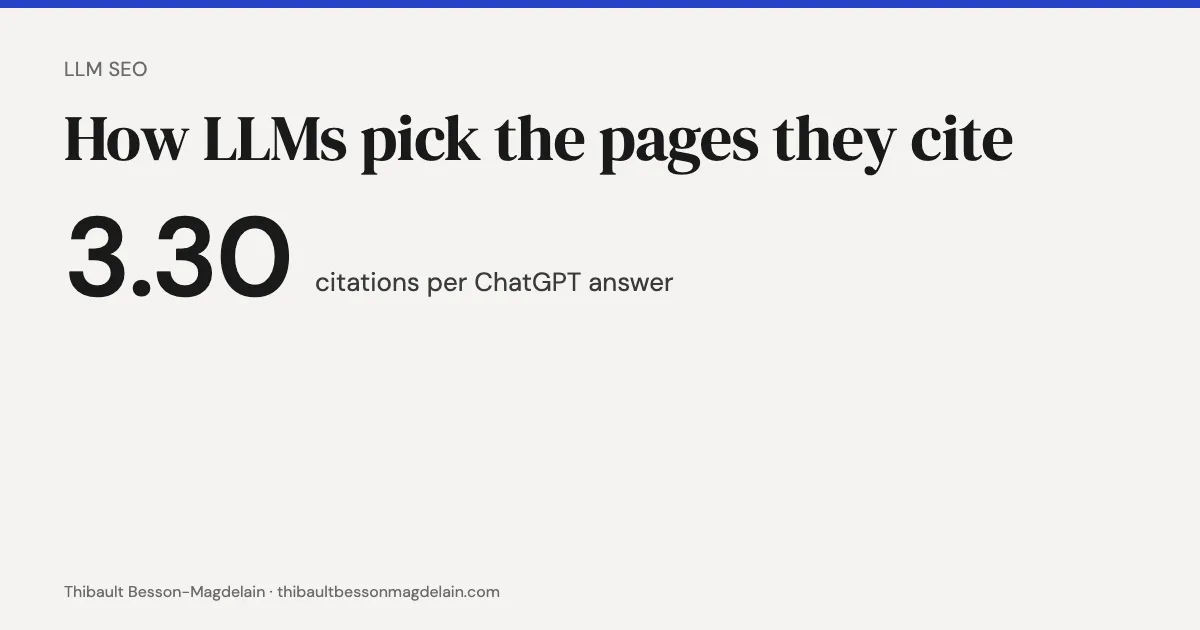
Few, and fewer than a year ago for some models. Across the whole period, ChatGPT gives 3.30 citations per answer, Perplexity 2.74, Claude 2.99, while Grok gives 6.72 and Gemini 9.21. With three links per answer, being the fourth best passage is the same as not existing.
The trend makes it tighter. ChatGPT went from 7.29 citations per answer in February 2026 (3,085 answers) to 2.13 in October 2026 (33,829 answers). Perplexity went from 5.39 to 1.97 over the same months. Part of the drop reflects the panel changing as it grew, so I would not read it as a precise rate. But the direction matches what anyone who uses these tools daily sees: shorter lists of sources, more concentrated on the most obvious ones.
Which pages do LLMs prefer to cite?
On business questions, LLMs prefer pages that confirm facts from outside the brand: review platforms, official sites, encyclopedias, directories. Trustpilot leads with 2.56 citations per 100 answers, service-public.gouv.fr follows with 2.36 and Wikipedia with 2.08. I detail the full ranking in which sources AI cites.
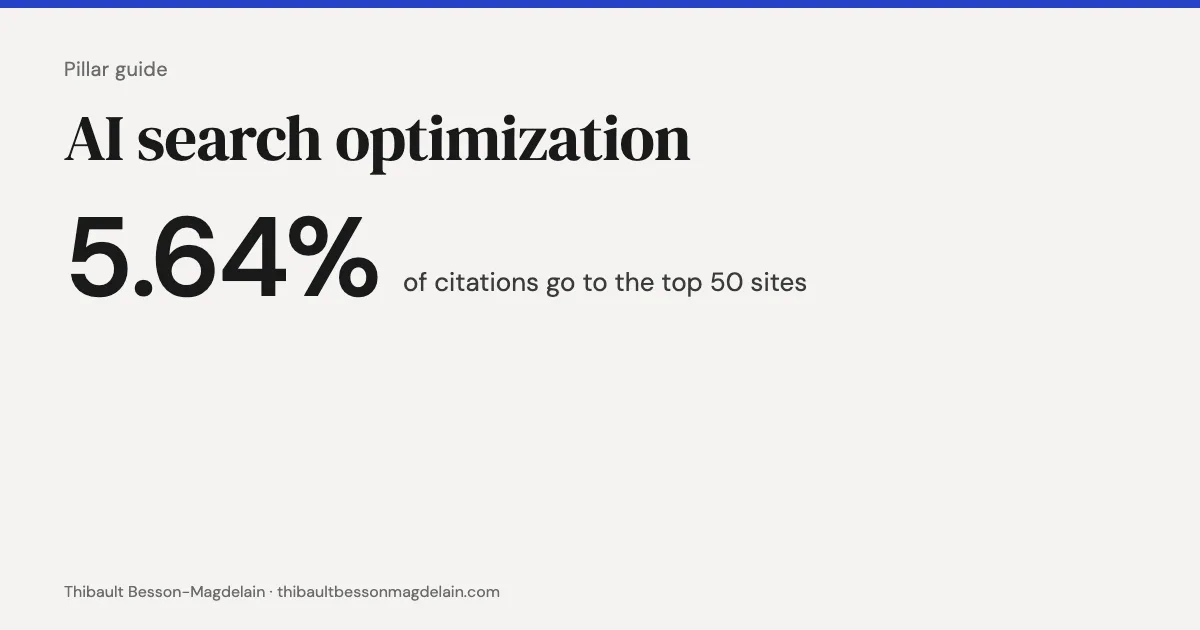
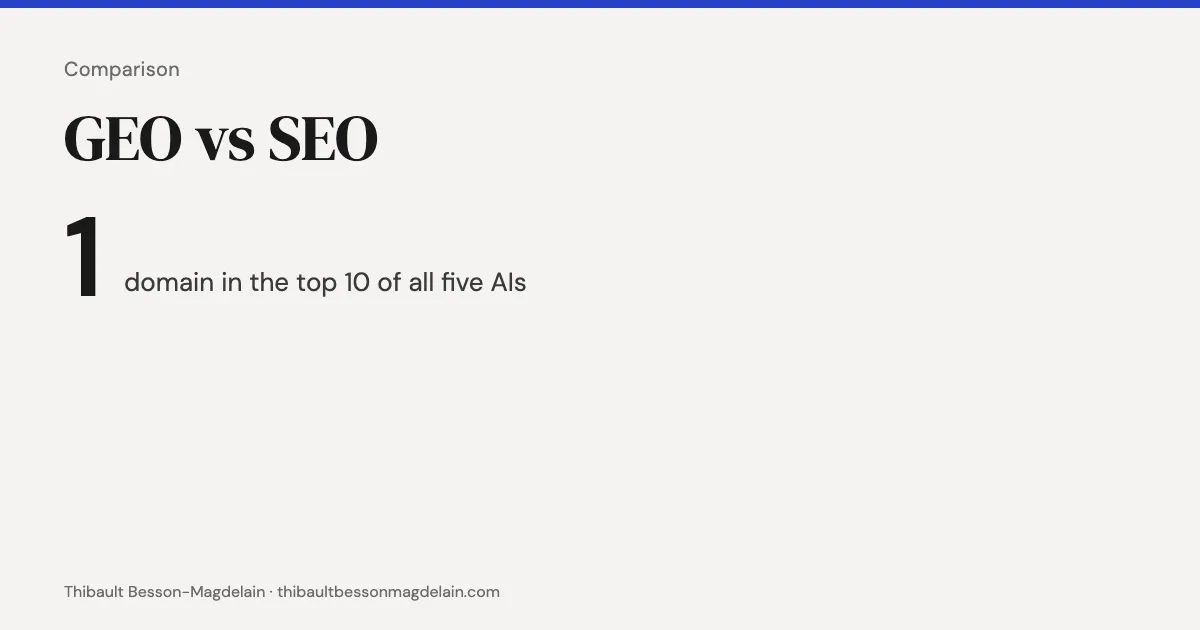
Two observations matter for LLM SEO. First, models disagree: only Trustpilot sits in the top 10 of all five AIs, and Claude cites Reddit 0.00 times per 100 answers while Gemini cites it 1.47 times. Second, the long tail is huge: 184,406 domains are cited, and the 50 most cited carry only 5.64% of all citations. Specialized pages, including brand pages, get the rest. The question is not "big platform or nothing", it is whether your passage is the best answer to a precise question.
In practice, this gives a brand two jobs that run in parallel. The first is to make its own pages the best passage for the narrow questions it can own: its prices, its process, its comparison with alternatives, its area of service. Nobody else can answer those as precisely, so a clear page tends to win them. The second is to make sure the third-party pages that answer the broad questions ("best X in Y", "is X reliable?") mention the brand correctly. A model asked a broad question will often cite a directory or a review platform; if your profile there is empty or wrong, your own page will not save you. I keep both lists side by side: questions my page should win, and questions where a third-party page will win and must name me.
What should you change on a page for LLMs?
Rewrite each section so that one passage answers one question completely, names its subject, and carries a verifiable fact. These are small edits, and they apply to pages you already have. Here is the list I apply, in order of impact:
- Question as heading, answer right below. The H2 is the buyer's question. The two to four sentences under it answer it fully. Details come after.
- Name the subject in every passage. Write "Sorank's AI mention tracking runs every week", not "It runs every week". A chunk that starts with "it" is an orphan.
- One idea per paragraph, 40 to 120 words. I find this size survives most chunking strategies. There is no official number, so treat it as my rule of thumb.
- Facts with units and sources. Prices with currency, delays in days, dates, and where the number comes from. The GEO paper (Aggarwal et al., KDD 2024) found that adding statistics and citations was among the methods that raised visibility, with gains of up to 40%.
- Tables for comparisons. A table keeps the relationship between the rows and the columns explicit, even when the text around it is cut.
- Visible date and author. Models favor current information on business topics. Show when the page was last checked.
- Text in the HTML. If your content is injected by JavaScript, check the raw source. Some AI fetchers do not render scripts.
A concrete before and after. Before: "Pricing: depends on your needs, contact us." After: "Our website audit costs between 800 and 1,500 euros for sites under 500 pages, delivered in 10 working days." The second version can be quoted; the first cannot. (The figures in this example are illustrative, not a real offer.) You can check how a page reads to a model with Sorank's LLM readability checker.
Do structured data and llms.txt help LLMs?
Structured data helps remove ambiguity, llms.txt is unproven. Schema markup tells machines who the organization is, who wrote the page, what the product costs. It does not force a citation, but it reduces the chance that a model confuses you with someone else. I cover which types matter in schema markup for AI search.
llms.txt is a proposed file that lists a site's key pages for language models. My opinion: it is cheap to add, but I have not seen OpenAI, Google or Anthropic document that their search products use it to pick sources. Do it after the basics, not instead of them. Google's position on its own AI features is the useful reference: "There are no additional requirements to appear in AI Overviews or AI Mode, nor other special optimizations necessary" (Google Search Central).
How can you check whether LLMs read and cite your pages?
Use three signals: server logs, referral traffic and answer tracking. Each one shows a different step of the pipeline, and you need all three to know where you drop out.
- Server logs. Look for OAI-SearchBot, ChatGPT-User, PerplexityBot, Googlebot and Bingbot hits on your key pages. No hits means you are not even in the candidate set.
- Referral traffic. Visits from chatgpt.com, perplexity.ai or gemini.google.com in your analytics show which pages are clicked from answers.
- Answer tracking. Ask the AIs a fixed set of buyer questions every month and record whether you are named and linked. This is the only way to see the citations that bring no click.
The third one is the most work by hand. Sorank's AI mention tracking runs it every week across the five models (plans on the pricing page).
So, what is LLM SEO in practice?
LLM SEO means making sure retrieval systems can fetch your page, that each passage answers one question on its own with verifiable facts, and that the third-party sources models trust confirm what you say. Models read passages, not sites, and they cite few of them: 3.30 per answer for ChatGPT, 2.74 for Perplexity. The passage that wins is the one that still makes sense once cut out of the page.
Start by finding out which of your pages are already cited, and for which questions. Track your citations in ChatGPT, Gemini, Perplexity, Claude and Grok with Sorank.
Sources
- Sorank Data, AI citation study, snapshot of 2 November 2026: citations per answer, top domains, monthly series.
- Lewis et al., "Retrieval-Augmented Generation for Knowledge-Intensive NLP Tasks", NeurIPS 2020: the retrieval-augmented generation design.
- Anthropic, "Introducing Contextual Retrieval", 19 September 2024: chunks lose context, 49% and 67% fewer failed retrievals.
- OpenAI, overview of OpenAI crawlers: OAI-SearchBot for search, GPTBot for training.
- Microsoft Advertising, "Optimizing Your Content for Inclusion in AI Search Answers", 8 October 2025: assistants break content into pieces.
- Aggarwal et al., "GEO: Generative Engine Optimization", KDD 2024: statistics and citations among the methods that raise visibility.
- Google Search Central, "AI features and your website": no special optimization required.
- Pew Research Center, 22 July 2025: about 1% of visits lead to a click on a link inside the AI summary.
FAQ
Is LLM SEO different from regular SEO?
It builds on regular SEO, since retrieval systems search an index first. The difference is the unit: SEO ranks pages, while LLMs pick passages and cite only a few per answer (3.30 on average for ChatGPT in the Sorank data). LLM SEO therefore focuses on self-contained, factual passages and on the third-party sources that models use to confirm facts.
How do I get my website into an LLM's training data?
You cannot submit a site for training. What you can do is allow the training crawlers (such as GPTBot) if you want to, and be described consistently on trusted sites that are widely crawled. For citations in answers, training data matters less than live retrieval, which you influence through indexable pages and presence on cited sources.
Which LLM cites the most sources?
Gemini, with 9.21 citations per answer on average in the Sorank data (snapshot of 2 November 2026), followed by Grok with 6.72. ChatGPT gives 3.30, Claude 2.99 and Perplexity 2.74.
Founder of Sorank, the SEO and GEO platform that tracks how ChatGPT, Gemini, Perplexity, Claude and Grok talk about brands. Before Sorank, I ran an SEO agency that served more than 100 clients. Based in Budapest.
Read next
-
AI Search Optimization: The Complete Method, Backed by 498,158 Answers
The full AI search optimization method, from eligibility to third-party sources and tracking, backed by 498,158 AI answers.
-
AEO Optimization: Answer Engine Optimization Explained, With a 12-Point Checklist
What answer engine optimization is, how it differs from SEO and GEO, and a 12-point checklist to become the answer AI engines give.
-
GEO vs SEO: What Changes, What Stays the Same, and What to Do
GEO vs SEO point by point: the shared foundation, what changes with AI answers, and how to split your effort between the two.
Continue on AI visibility: all articles on the blog