AI Rank Tracker: How AI Rank Tracking Works and What to Look For
There is no stable position in an AI answer, so an AI rank tracker measures frequencies. Here is how the method works, which metrics matter, how many runs you need, and how to judge a tool.

Published · Updated · 11 min read
Contents
- What is an AI rank tracker?
- How does AI rank tracking work?
- Which metrics should an AI rank tracker report?
- Which questions belong in the panel?
- How many prompts and runs do you need?
- Why should you track each AI separately?
- How often should you track AI rankings?
- What should you look for in an AI rank tracker?
- Can you track AI rankings by hand?
- FAQ
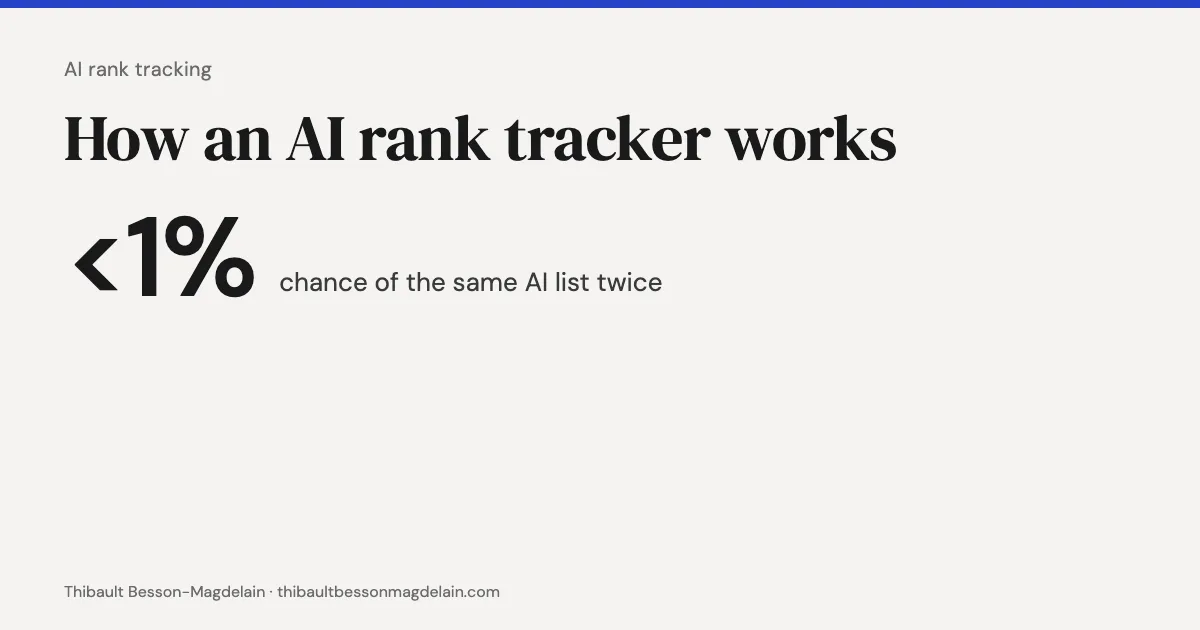
An AI rank tracker measures how often ChatGPT, Gemini, Perplexity, Claude, Grok or Google's AI features name your brand and link to your site when people ask the questions of your market. It is the AI equivalent of a classic rank tracker, with one big difference: there is no stable rank to track. SparkToro's January 2026 study of 2,961 runs found "a <1 in 100 chance" that ChatGPT or Google's AI gives the same list of brands in two responses. A useful tracker is built around that fact.
I built one. Sorank, my company, asks the same buyer questions to five AIs every week, and the aggregated results of 498,158 answers collected between August 2025 and October 2026 are public on sorank.com/data (snapshot of 2 November 2026). So read this guide knowing I have a stake: I will explain how the method works and what to demand from any tool, and I will say clearly when I talk about mine.
What is an AI rank tracker?
An AI rank tracker is software that runs a fixed set of buyer questions through several AI assistants on a schedule, then records whether your brand is named, whether your pages are linked, which competitors appear and which sources are cited. The output is a set of rates over time, per AI.
The name is a bit misleading. In a Google results page, position 3 means something stable for days or weeks. In an AI answer, the list of brands and their order change from one run to the next. That is why serious trackers report frequencies (how often you appear across many runs) rather than a single position. You will also see these tools called AI visibility trackers or AI mention trackers; Sorank's own is described on the AI visibility tracker page (my tool, so weigh that page accordingly).
How does AI rank tracking work?
Every tool follows the same four steps: build a question panel, run it on each AI several times, parse the answers, and aggregate the results. The quality of a tracker depends on how well it does each step, not on its dashboard.
- Panel. A list of questions your buyers actually ask: "best accounting software for freelancers", "is X reliable?", "X or Y for a 10 person team?". Not your brand name alone, which only tells you what the AI knows about you, not whether it recommends you.
- Runs. Each question goes to each AI, with web search on when the product allows it, several times. One run per question is an anecdote.
- Parsing. The tool extracts the brands named, their order, the links given, and the tone used. Brand detection must handle spelling variants and similar names.
- Aggregation. Results are rolled up per AI, per question group and per period, with your competitors alongside.
Which metrics should an AI rank tracker report?
Two metrics matter most: the mention rate (share of answers that name you) and the citation rate (share of answers that link to your site). Everything else is context. Rand Fishkin, who ran the SparkToro study, put the conclusion simply:
"visibility % across dozens to hundreds of prompts run multiple times is a reasonable metric."Rand Fishkin, SparkToro, 28 January 2026 (sparktoro.com)
| Metric | How it is computed | What it tells you | Watch out for |
|---|---|---|---|
| Mention rate | Answers naming you ÷ answers | Whether AIs recommend you | Needs many runs to be stable |
| Citation rate | Answers linking your site ÷ answers | Whether your pages are used as proof | Low on models that cite few links |
| Share of voice | Your mentions ÷ all brand mentions in the panel | Your weight against competitors | Depends on which competitors you track |
| Average position | Order of your name in the answer | Prominence when named | Very noisy run to run |
| Sources cited | Domains linked in answers on your questions | Where to be present off-site | Changes month to month |
| Sentiment | Tone of the sentence that names you | Whether you are recommended or warned against | Automatic scoring makes mistakes |
Share of voice deserves its own article, which I wrote: how to compute AI share of voice.
Which questions belong in the panel?
A good panel mixes four kinds of questions, in roughly the proportions your buyers ask them. If the panel only contains your brand name, you measure your reputation, not your visibility.
- Discovery. "Best project management tool for a small agency", "plumber in Lyon open on Sunday". This is where new customers find you, and where most brands are missing.
- Comparison. "X or Y for invoicing?", "alternatives to X". The AI often builds a table here, and the sources it cites are the comparison sites of your market.
- Trust. "Is X reliable?", "X reviews". The answer leans on review platforms: in the Sorank data, Trustpilot is the only domain in the top 10 of all five AIs.
- Brand facts. "How much does X cost?", "where is X based?". These check that the AI repeats correct facts about you.
Keep the wording natural and varied. SparkToro also found that people phrase the same need in very different ways, so a panel of near-identical prompts overstates your stability. Freeze the panel once it is built: if you change the questions every month, you cannot tell whether a change comes from the AI or from your panel. Add new questions as a separate group instead.
How many prompts and runs do you need?
More than most people think. A mention rate is a proportion, and a proportion measured on few answers has a wide margin of error. SparkToro ran each of its 12 prompts roughly 60 to 100 times before drawing conclusions.
Here is the plain statistics, for a brand named in 30% of answers, with a 95% confidence interval:
| Answers measured | Margin of error | What you can conclude |
|---|---|---|
| 20 | ±20 points | Almost nothing: 10% and 50% are both plausible |
| 50 | ±13 points | A rough level, not a trend |
| 200 | ±6 points | A usable monthly level per AI |
| 1,000 | ±3 points | Month-to-month changes become readable |
In practice, I aim for 30 to 100 questions per market, each run several times on each AI every month. Small samples happen even in large datasets: in the Sorank panel, Claude was asked 148 questions in April 2026 and 101 in May 2026, so any Claude figure for those months is indicative only. A good tool shows you the sample size next to every rate. If it does not, ask.
Why should you track each AI separately?
Because they behave like different search engines. They do not cite the same number of sources, nor the same sources. Gemini gives 9.21 citations per answer on average, Perplexity 2.74. Only Trustpilot is in the top 10 of all five models, and even then its weight varies by a factor of nine.
An average "AI visibility score" across models hides these gaps. If your buyers use ChatGPT and your tracker averages it with Grok, a gain on Grok can hide a loss on ChatGPT. Ask for per-model results first, and an aggregate second. For ChatGPT specifically, Sorank has a dedicated ChatGPT rank tracker page.
How often should you track AI rankings?
Run weekly, report monthly. Weekly runs give you enough answers to compute stable rates; monthly reports smooth out the noise and match how fast sources really move.
And they do move. In the Sorank panel, Wikipedia fell from 11.31 citations per 100 answers in October 2025 to 0.12 in October 2026. Trustpilot rose from 0.29 in October 2025 to 4.44 in March 2026, then fell back to 1.27 in October 2026. ChatGPT itself went from 7.29 citations per answer in February 2026 to 2.13 in October 2026. Part of these swings comes from the panel growing (5,925 answers in October 2025, 110,687 in October 2026), but a quarterly check would miss them entirely. I describe the brand-side audit, including how to fix wrong facts AIs repeat, in what ChatGPT says about your brand.
What should you look for in an AI rank tracker?
Judge a tool on method transparency first, features second. A beautiful dashboard built on five runs per month is worse than a spreadsheet built on two hundred. These are the criteria I would use if I were buying, not selling:
| Criterion | Why it matters | Question to ask |
|---|---|---|
| Models covered | Your buyers may use any of them | Which AIs, and with web search on? |
| Runs per question | Rates need volume | How many answers per question per month? |
| Sample size shown | To judge if a change is real | Is n displayed next to each rate? |
| Per-model results | Averages hide gaps | Can I see each AI separately? |
| Sources cited | Tells you where to act off-site | Do I see every linked domain? |
| Competitors | Share of voice needs a frame | Are competitors detected automatically? |
| Question research | A bad panel gives bad data | Does it help me find real buyer questions? |
| Raw answers | To verify the parsing | Can I read the full answer text? |
| Languages and countries | Sources differ by market | Can I run the panel in French and English? |
On categories: some classic SEO suites have added AI modules, dedicated AI visibility tools have appeared, and free one-off checkers exist. The suites are convenient if you already pay for one; the dedicated tools usually go deeper on runs and sources; the free checkers are fine for a first look but give you one run, which is an anecdote. I compare the categories in more detail in AI visibility tools. Building a good panel is the hardest part, which is why Sorank includes AI prompt research.
Can you track AI rankings by hand?
Yes, for a small panel and a first diagnosis. It is the best way to understand the problem before paying for anything. Here is the routine:
- Write 10 to 20 buyer questions in your buyers' words, mixing recommendation, comparison and trust questions.
- Ask each one to each AI three times, in a fresh session, web search on where possible.
- Log one row per answer in a spreadsheet: date, AI, question, brands named in order, domains linked.
- Compute two rates per AI: answers naming you ÷ answers, answers linking you ÷ answers.
- Repeat monthly with exactly the same questions.
Twenty questions, five AIs, three runs: 300 answers a month, a few hours of work. It breaks down when you need more questions, more markets or weekly runs. That is the point where a tool pays for itself. Plans for mine are on the Sorank pricing page.
So, what makes a good AI rank tracker?
A good AI rank tracker runs a fixed panel of real buyer questions several times on each AI, reports mention rate and citation rate per model with the sample size, and shows the sources cited, every week. Positions in AI answers are too unstable to track alone: SparkToro found under a 1 in 100 chance of the same list twice. Frequencies over hundreds of answers are what you can trust.
If you want to see these rates for your brand without building the spreadsheet, try Sorank's AI visibility tracker (my tool, with the method described above).
Sources
- SparkToro, Rand Fishkin, "AIs are highly inconsistent when recommending brands or products", 28 January 2026: 2,961 runs, under 1 in 100 chance of the same list, visibility % as a metric.
- Sorank Data, AI citation study, snapshot of 2 November 2026: citations per answer, per-AI sources, monthly series and samples.
- Sorank Data, methodology: how the panel is built and its limits.
- OpenAI, overview of OpenAI crawlers: OAI-SearchBot, the crawler behind ChatGPT search results.
- Google Search Central, "AI features and your website": how AI Overviews and AI Mode select supporting links.
FAQ
Can I track my brand's position in ChatGPT?
You can track how often ChatGPT names you and links to you, but not a stable position: the list and order of brands change between runs. Ask a fixed set of buyer questions several times each month and compute a mention rate and a citation rate. With enough answers (200 or more per AI), the rate becomes a reliable indicator.
What is a good AI mention rate?
It depends on how crowded your market is and on how many brands an AI names per answer. Compare yourself with your direct competitors on the same questions (share of voice) rather than against an absolute target, and watch the trend per AI month by month.
Are free AI visibility checkers reliable?
They are useful for a first look, but most run each question once, and a single answer is an anecdote: SparkToro found that the same list of brands almost never repeats. Use them to spot obvious gaps, then measure with repeated runs before drawing conclusions.
Founder of Sorank, the SEO and GEO platform that tracks how ChatGPT, Gemini, Perplexity, Claude and Grok talk about brands. Before Sorank, I ran an SEO agency that served more than 100 clients. Based in Budapest.
Read next
-
GEO vs SEO: What Changes, What Stays the Same, and What to Do
GEO vs SEO point by point: the shared foundation, what changes with AI answers, and how to split your effort between the two.
-
How to Rank in ChatGPT: 7 Steps Backed by Real Data
How ChatGPT picks the brands it recommends, what it cites, and the 7 steps to get into its answers.
-
AEO Optimization: Answer Engine Optimization Explained, With a 12-Point Checklist
What answer engine optimization is, how it differs from SEO and GEO, and a 12-point checklist to become the answer AI engines give.
Continue on AI visibility: all articles on the blog