What Does ChatGPT Say About My Brand? How to Audit and Fix It
ChatGPT repeats what the pages it reads say about you, and guesses where they are silent. Here is how to audit its answers, trace each wrong fact to its source, and fix it there.

Published · Updated · 8 min read
Contents
- How do you check what ChatGPT says about your brand?
- Why does ChatGPT get facts about brands wrong?
- Which sources does ChatGPT use when it talks about businesses?
- How do you fix wrong information ChatGPT gives about your brand?
- Why does entity consistency matter so much?
- How often should you check what AI says about your brand?
- FAQ
To find out what ChatGPT says about your brand, ask it the questions your buyers ask, with web search on, in a fresh session, and record three things each time: whether you are named, what facts it states about you, and which links back them. Then do the same in Gemini, Perplexity, Claude and Grok. It takes an hour, and the stakes are real: 34% of US adults had used ChatGPT by early 2025, according to Pew Research Center, about double the 2023 share.
I build Sorank, which asks five AIs the same buyer questions every week and logs every brand they name and every link they give. Before that I ran an SEO agency with more than 100 clients, where "why does Google show this about us?" was a weekly question. "Why does ChatGPT say this about us?" is the same question with a new address. Below: the audit method, the sources ChatGPT actually relies on (from 498,158 AI answers, snapshot of 2 November 2026), and how to fix wrong facts at their source.
How do you check what ChatGPT says about your brand?
Ask two kinds of questions: brand questions ("What is [brand]?", "Is [brand] reliable?", "[brand] prices") and category questions without your name ("best [service] in [city]"). The first shows what ChatGPT believes about you. The second shows whether it thinks of you at all. Most companies only check the first and miss the bigger problem.
- Use a clean session. Log out or use a temporary chat, so your history and memory do not bias the answer.
- Turn web search on, then off. With search, ChatGPT reads current pages and shows links. Without it, you see what the model learned in training. The two can disagree, and both matter.
- Write 10 to 20 questions. Five about your brand (identity, reliability, prices, alternatives, reviews), the rest about your category.
- Run each question three times. Answers vary between runs. A fact that appears once may be noise; a fact that appears three times is what ChatGPT believes.
- Record everything in a sheet. Named or not, rank in the list, facts stated, tone, links given.
- Repeat in the other AIs. Gemini, Perplexity, Claude and Grok each have their own sources, so they can be right where ChatGPT is wrong.
If you only want a quick first look, Sorank's free ChatGPT visibility checker runs a test on your site.
Why does ChatGPT get facts about brands wrong?
Because a small company is a rare fact for a language model, and models guess when they are unsure. OpenAI says it plainly in its research post on hallucinations:
"ChatGPT also hallucinates. GPT‑5 has significantly fewer hallucinations, especially when reasoning, but they still occur."OpenAI, "Why language models hallucinate", September 2025
The same OpenAI post explains that arbitrary, low-frequency facts (its example is a person's birthday) cannot be predicted from patterns, which is where errors come from. Your founding year, your prices or your address are exactly that kind of fact. Add two other causes I see all the time: outdated pages (an old directory listing with your former address, a press article about a product you dropped) and namesakes (another company with a similar name in another country). With search on, ChatGPT repeats what the pages it finds say. If those pages are wrong, the answer is wrong.
Which sources does ChatGPT use when it talks about businesses?
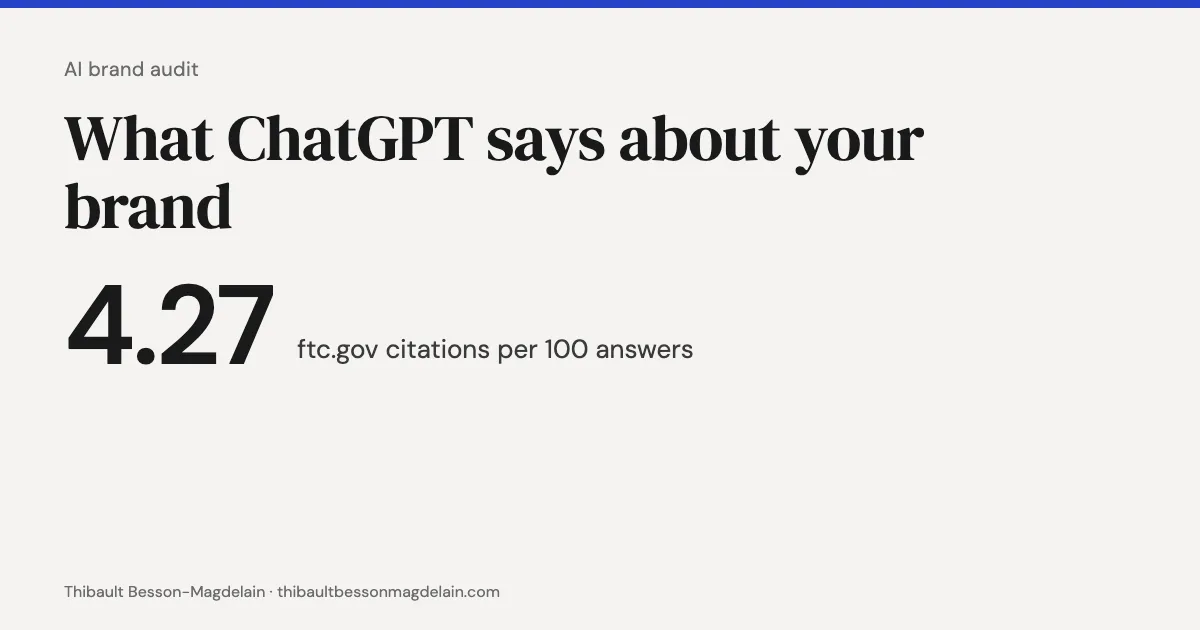
Mostly official and reference sites, and the mix depends on the language. In Sorank's data, ChatGPT's most cited sites in English business answers are ftc.gov (4.27 citations per 100 answers), Amazon (4.12), Wikipedia (2.27) and Trustpilot (2.18). In French answers, government sites and Wikipedia dominate.
Across all languages, ChatGPT's top sources are service-public.gouv.fr (5.98 citations per 100 answers), Wikipedia (5.38) and economie.gouv.fr (4.30), over 148,295 ChatGPT answers. The French government sites rank high because the panel is mostly French: 435,183 of the 498,158 answers are in French. The lesson is not "get on a government website". It is that ChatGPT trusts neutral reference pages and review platforms more than your own site. Other AIs pick different sources: Claude's first source is pagesjaunes.fr (3.33), Gemini's is Trustpilot (4.31). My study of which sources AI cites covers the full ranking.
My take: the fastest way to change what ChatGPT says about you is rarely your homepage. It is the five or six third-party pages it reads about you.
How do you fix wrong information ChatGPT gives about your brand?
Fix the source, not the chatbot. There is no form where a business can edit ChatGPT's answers, so you correct the pages it reads, make your own site the clearest statement of the facts, and check again a few weeks later.
| What you see | Likely cause | Fix | When to re-check |
|---|---|---|---|
| Wrong fact (price, address, founder) | Outdated third-party page, or a model guess | Correct the cited page; state the fact clearly on your site | A few weeks with search on; later without |
| Confused with a namesake | Weak entity signals | Consistent name, city and category everywhere; Organization schema with sameAs | Next month |
| Old offer or old name | Old articles and listings | Update listings; publish a clear "what changed" page | Next month |
| Negative tone | Real reviews or one loud thread | Answer reviews, collect recent ones, fix the real issue | Quarterly |
| Not named at all | No presence on the sources it cites | Get listed and reviewed where ChatGPT looks | Monthly |
- Open the links in the answer. With search on, ChatGPT shows its sources. The wrong fact usually comes from one of them.
- Correct what you control. Your website, your Google Business Profile, your social profiles, your directory listings, your review platform pages.
- Request corrections elsewhere. Write to the editor of an outdated article or directory. On Wikipedia, do not edit your own company page: the guideline says editors with a conflict of interest "are strongly discouraged from editing affected articles directly, and can propose changes on article talk pages instead" (Wikipedia, conflict of interest).
- Publish a clear facts page. An About page with founding year, founders, location, what you do and do not offer, in plain sentences. Mark it up with Organization schema (see my guide on schema markup for AI search).
- Make sure ChatGPT can read your site. OpenAI's publishers FAQ explains that sites must not block OAI-SearchBot to appear in ChatGPT search. Check your robots.txt.
Why does entity consistency matter so much?
Because an AI builds its picture of your company from many pages, and every contradiction is a coin toss. If your site says "founded in 2016", LinkedIn says 2017 and an old directory says 2014, the model may pick any of them, or average them into nonsense.
Entity consistency means one name, one address, one category, one description, one set of key facts, everywhere. The checklist I use:
- Name: exactly the same spelling, with or without legal suffix, on every profile.
- Address and phone: identical on your site, Google Business Profile and directories.
- Category: the same main activity everywhere. "Web agency" here and "IT consulting" there splits your identity.
- Description: one 2 sentence description reused across profiles.
- Links: each profile links to your site, and your site's Organization schema links back with sameAs.
Sorank's glossary calls this entity consensus: the more sources agree on who you are, the more confidently an AI repeats it.
How often should you check what AI says about your brand?
Every month for the brand questions, and every week if AI is a real acquisition channel for you. The sources behind the answers move fast. In Sorank's panel, ChatGPT's total citations went from 728.59 per 100 answers in February 2026 to 213.45 in October 2026, and Wikipedia went from 11.31 citations per 100 answers in October 2025 to 0.12 in October 2026 across all AIs. A correct answer this month says little about next month.
Doing it by hand works for one brand and ten questions. For five AIs, several runs and a history you can show to a manager, a tool is the realistic option: Sorank's AI mention tracking logs every answer, every brand named and every link, and plans are on the pricing page. To turn mentions into one comparable number, read my guide to AI share of voice.
So, what does ChatGPT say about your brand?
Whatever the pages it reads say about you, plus a few guesses where those pages are silent. Ask it your buyers' questions in a clean session, open the links behind each answer, correct the pages that are wrong, keep your facts identical everywhere, and check again every month. You cannot edit ChatGPT, but you can edit almost everything it reads.
To see what ChatGPT and four other AIs say about you every week, with sources, start tracking your brand in ChatGPT with Sorank.
Sources
- OpenAI, "Why language models hallucinate", September 2025: ChatGPT still hallucinates; rare facts drive errors.
- OpenAI, "Publishers and developers FAQ": OAI-SearchBot and ChatGPT search.
- Wikipedia, "Conflict of interest" guideline: propose changes on talk pages.
- Pew Research Center, 25 June 2025: 34% of US adults have used ChatGPT.
- Sorank Data, snapshot of 2 November 2026: ChatGPT citations by domain and language.
FAQ
Can I ask OpenAI to correct what ChatGPT says about my company?
There is no public form for businesses to edit ChatGPT's answers. The practical route is to correct the pages ChatGPT cites, make your own site state the facts clearly, and check again after a few weeks with search on.
Why does ChatGPT give different answers about my brand each time?
Answers are generated, not looked up, so they vary between runs, and with search on they depend on the pages found at that moment. That is why you should run each question several times and look at what comes back consistently.
How long does it take for ChatGPT to update information about my brand?
With web search on, a corrected page can show up as soon as ChatGPT reads it again, often within weeks. Without search, the answer comes from training data and changes only when a newer model is released.
Founder of Sorank, the SEO and GEO platform that tracks how ChatGPT, Gemini, Perplexity, Claude and Grok talk about brands. Before Sorank, I ran an SEO agency that served more than 100 clients. Based in Budapest.
Read next
-
Online Reputation Management: Your Brand in Google and in AI
What Google and AI say about your brand, which sources they quote, and how to improve it.
-
How to Get Trustpilot Reviews, the Legit Way, and Why AI Cares
Invite every customer, offer no incentive, reply, and why AI cites Trustpilot more than any site.
-
How to Respond to Negative Reviews (With Templates)
A 5-part structure, 6 templates and the mistakes to avoid, with data on the review pages AI assistants cite.
Continue on AI visibility: all articles on the blog