Online Reputation Management: Your Brand in Google and in AI
Your reputation used to be page one of Google. Now it is also the paragraph ChatGPT writes when someone asks if you are reliable. Here is what makes up a brand's reputation in both places, what the data says about the sources AI trusts, and the method I would follow.

Published · Updated · 10 min read
Contents
Online reputation management is the work of shaping what people find when they look you up: the reviews, the articles, the listings and, increasingly, the answer an AI assistant gives when asked "is this company reliable?". That last part is new and growing fast: 34% of US adults had used ChatGPT by early 2025, according to Pew Research Center, about double the share of 2023.
An AI does not invent a reputation. It reads the web and quotes it. So the question is no longer only "what is on page one of Google?" but "which sources does each AI quote about me, and what do they say?". I build Sorank, which asks those questions to ChatGPT, Gemini, Perplexity, Claude and Grok every week, and its public dataset of 498158 answers shows which sources carry the most weight. Before Sorank I ran an SEO agency with more than 100 clients, so I will keep this practical.
What is online reputation management?
It is monitoring, improving and protecting what the internet says about a brand or a person. In practice: collecting real reviews and answering them, correcting wrong information at its source, publishing content that answers the questions people ask about you, and earning mentions on sites that search engines and AIs trust.
It is not the art of hiding bad news. Search engines and AIs both look for consistency across many independent sources. You cannot fake that for long, but you can make sure the true, positive and current version of your story is the one they find.
What makes up a brand's reputation in Google?
Your reputation in Google is the first page of results for your brand name, plus the panel on the right and the review stars. Typically: your website, your Google Business Profile with its rating, review platforms, social accounts, directories, press articles, sometimes Wikipedia and forum threads.
Two parts weigh more than the rest. The rating shown next to your name, because it is the first number a prospect sees, and the third-party pages that rank for "brand + reviews" or "brand + scam", because that is where hesitant buyers click. Google itself says that for local businesses, "more reviews and positive ratings can help your business's local ranking" (Google Business Profile Help). I cover the brand results page in detail in brand SERP.
What makes up a brand's reputation in AI answers?
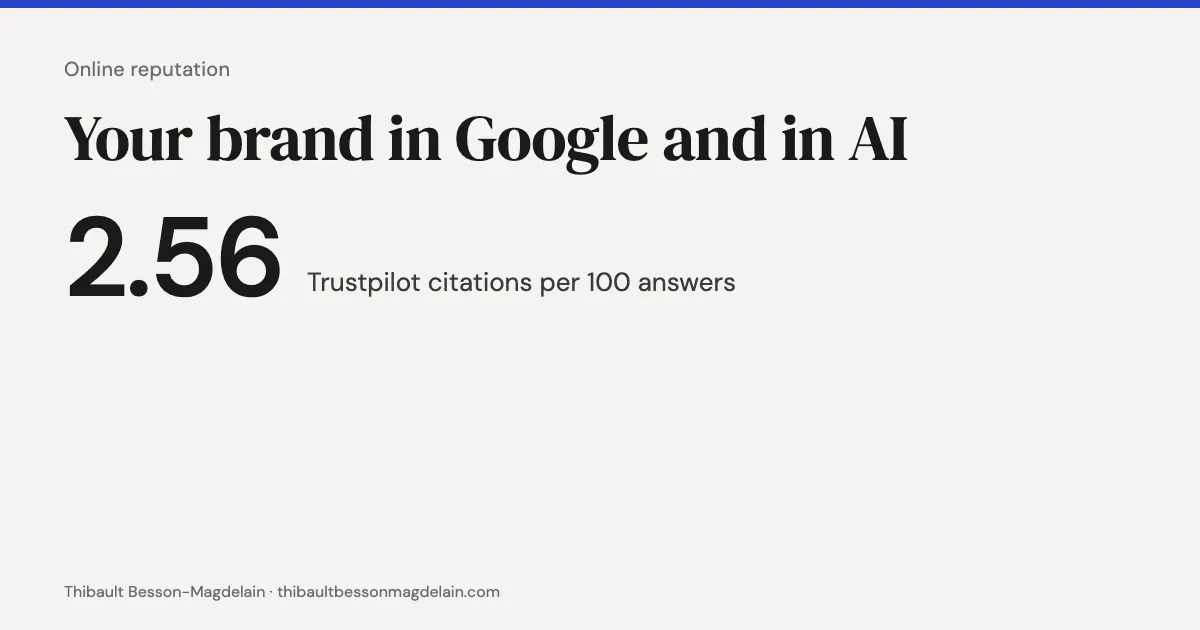
Mostly third-party sources: review platforms, official sites, Wikipedia and directories. Across 498158 answers from five AIs collected by Sorank between August 2025 and October 2026 (snapshot of 2 November 2026), the most cited website is Trustpilot, with 2.56 citations per 100 answers, ahead of service-public.gouv.fr (2.36) and Wikipedia (2.08).
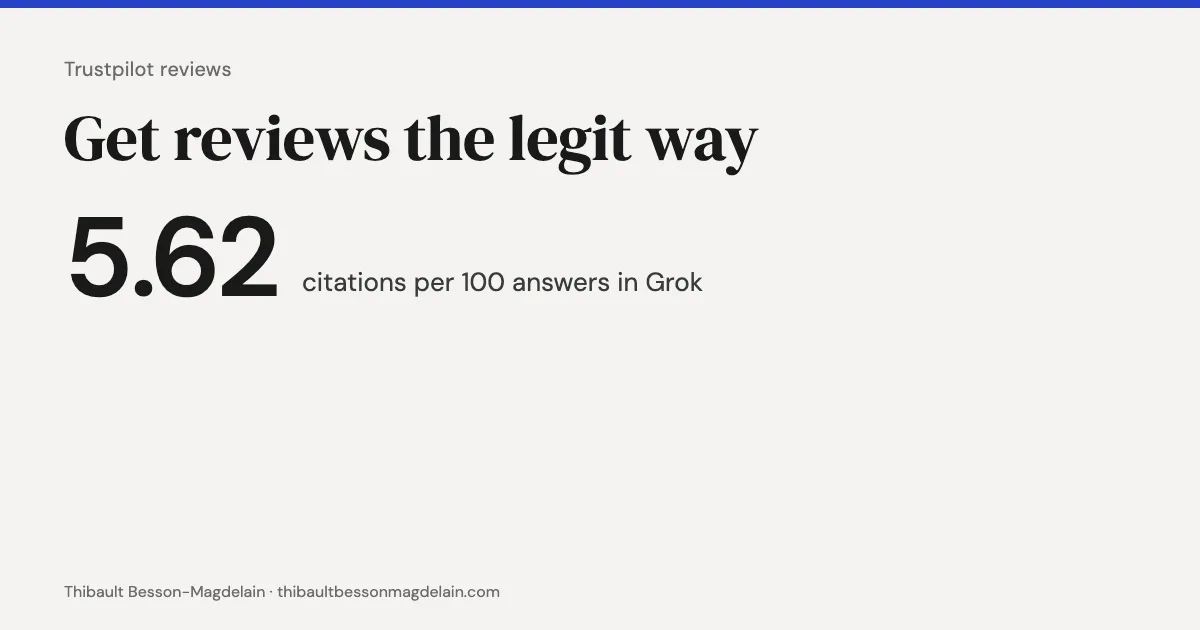
Each AI weighs review platforms differently. Grok cites Trustpilot 5.62 times per 100 answers and Gemini 3.93 times, while Claude cites it 0.80 times and leans more on directories. TripAdvisor matters most for Grok (2.09) and Perplexity (1.31). Employer review sites like Glassdoor barely register on business questions.
| Platform | ChatGPT | Gemini | Perplexity | Claude | Grok |
|---|---|---|---|---|---|
| Trustpilot | 1.83 | 3.93 | 1.08 | 0.80 | 5.62 |
| TripAdvisor | 0.67 | 0.51 | 1.31 | 1.09 | 2.09 |
| 0.12 | 0.94 | 0.59 | 0.19 | 1.58 | |
| Indeed | 0.10 | 0.43 | 0.23 | 0.06 | 0.13 |
| Yelp | 0.01 | 0.05 | 0.08 | 0.18 | 0.42 |
| Glassdoor | 0.03 | 0.08 | 0.02 | 0.01 | 0.03 |
Consumer protection sites also appear. In English-language answers, ftc.gov gets 1.13 citations per 100 answers and bbb.org (Better Business Bureau) 0.54; in French ones, quechoisir.org gets 0.31. My reading: when the question touches trust, the AI goes looking for an independent referee. If a complaint about you sits on one of those sites, assume the AI can find it. For a step-by-step check of your own brand, see what ChatGPT says about your brand.
Why does online reputation matter so much now?
Because reviews decide purchases, and regulators now treat them as a consumer protection issue. When the stakes get that high, manipulation follows, and so does enforcement.
In January 2022, the European Commission published the results of a coordinated screening by consumer authorities of 26 member states, Iceland and Norway: of 223 major websites checked, at least 55% potentially violated the Unfair Commercial Practices Directive, and for 144 of them authorities could not confirm that enough was done to ensure reviews were authentic. In the United States, the Federal Trade Commission adopted on 14 August 2024 a final rule banning fake reviews and testimonials, including AI-generated ones.
For a business, this cuts both ways. Buyers and AIs have learned to distrust a perfect 5.0 with twelve reviews. A 4.5 with hundreds of detailed, recent, answered reviews on a platform with real verification is worth more, to people and to machines.
How do you audit your online reputation?
Look where your buyers look: Google results for your name, and the answers of the five main AIs. Write down every source, what it says, and whether it is accurate. It takes about two hours the first time.
- Google your brand. Brand name alone, then "brand + reviews", "brand + scam", "brand + complaints", "brand + alternatives", in a private window. List every result on page one with its tone: positive, neutral, negative, wrong.
- Check your ratings. Google, Trustpilot, the platform of your trade (TripAdvisor, booking sites, software comparison sites). Note the score, the number of reviews, the date of the last one, and whether you answered.
- Ask the AIs. "Is [brand] reliable?", "What do customers say about [brand]?", "Best [category] in [city]", in ChatGPT, Gemini, Perplexity, Claude and Grok with web search on. Note what they say and which links they give.
- Spot the errors. Old prices, a former address, a product you no longer sell, a confusion with a namesake. AIs repeat those confidently.
- Rank the issues. A wrong fact repeated by three AIs comes before a two-year-old negative review.
How do you improve your online reputation?
Fix facts at their source, earn a steady flow of real reviews, answer every review, and publish clear content that answers the questions people ask about you. In that order.
- Correct the sources, not the AI. You cannot edit ChatGPT's answer. You can update your Google profile, your directory listings, your About page and the press page that has the wrong date. The AI follows.
- Ask every happy customer for a review. Right after a good experience, with a direct link, on the platform that matters for your market. Never conditioned on a positive rating. For Trustpilot specifically, I detail the allowed methods in how to get Trustpilot reviews.
- Answer reviews, negative ones first. Calm, factual, with a solution. The answer is read by future customers, and quoted by AIs, more than the complaint itself.
- Publish the answers yourself. A clear page on pricing, guarantees, delivery times, how complaints are handled. When an AI looks for these facts, give it an official source. The researchers who coined the term GEO (optimization for generative engines) found that pages with sources, statistics and quotations gain visibility in AI answers: "GEO can boost visibility by up to 40% in generative engine responses" (Aggarwal et al., KDD 2024).
- Earn independent mentions. Industry directories, local press, partner pages, podcasts. Each one is another source that can confirm who you are.
Sorank's own guide to online reputation management covers more tactics on the Google side.
What should you never do?
Never buy, write or incentivize fake reviews, never threaten reviewers, and never pretend a company-controlled site is independent. Beyond the legal risk, it fails: platforms and AIs look for consistency, and a sudden burst of five-star reviews is the opposite of it.
"Fake reviews not only waste people's time and money, but also pollute the marketplace and divert business away from honest competitors."Lina M. Khan, Chair of the US Federal Trade Commission, 14 August 2024
The FTC rule also bans offering incentives conditioned on a positive or negative review, insider reviews that hide their connection to the business, and suppressing negative reviews through groundless legal threats or intimidation. In Europe, the Unfair Commercial Practices Directive covers the same ground. Other things I would avoid: deleting critical comments on your own pages, flooding results with thin pages to push down a bad article, and arguing with a reviewer in public.
So, how do you manage your online reputation today?
Online reputation management now covers two audiences, Google and AI assistants, and both rely on the same thing: consistent, independent sources, led by review platforms, that confirm who you are. Audit what they say, fix facts at their source, earn and answer real reviews, and measure it every month, AI by AI.
To see what ChatGPT, Gemini, Claude, Perplexity and Grok say about you and which sites they quote, start tracking your AI mentions with Sorank (plans on the pricing page).
Sources
- Sorank Data, snapshot of 2 November 2026: citation figures by AI and by platform.
- US Federal Trade Commission, 14 August 2024: final rule banning fake reviews and testimonials.
- European Commission, press release IP/22/394, January 2022: 223 websites screened, at least 55% potentially in breach.
- Google Business Profile Help, "Tips to improve your local ranking on Google": reviews and ratings help local ranking.
- Pew Research Center, 25 June 2025: 34% of US adults have used ChatGPT.
- Aggarwal et al., "GEO: Generative Engine Optimization", KDD 2024: up to 40% visibility gain.
FAQ
How long does it take to repair an online reputation?
Corrections to your own profiles and listings show within weeks. A new flow of reviews needs a few months to move an average rating. A negative press article can stay on page one for years, so the realistic goal is to surround it with stronger, more recent sources.
Can I remove a negative review?
Only if it breaks the platform's rules (fake, off-topic, hateful, conflict of interest). You can report it to the platform. Otherwise the best move is a calm, factual public reply, which future customers and AI assistants will read alongside the review.
Does ChatGPT know my company's reputation?
When it searches the web, ChatGPT builds its answer from the pages it finds, often review platforms, official sites and Wikipedia. Ask it directly with web search on, note the links it gives, and fix any wrong information on those sites rather than on your own.
Founder of Sorank, the SEO and GEO platform that tracks how ChatGPT, Gemini, Perplexity, Claude and Grok talk about brands. Before Sorank, I ran an SEO agency that served more than 100 clients. Based in Budapest.
Read next
-
How to Get Trustpilot Reviews, the Legit Way, and Why AI Cares
Invite every customer, offer no incentive, reply, and why AI cites Trustpilot more than any site.
-
How to Respond to Negative Reviews (With Templates)
A 5-part structure, 6 templates and the mistakes to avoid, with data on the review pages AI assistants cite.
-
How to Remove a Google Review: What Google Deletes and What Stays
What Google deletes, how to report and appeal, the legal route in the EU and US, and what to do with a review that stays.
Continue on reputation and AI visibility: all articles on the blog