Best AI Visibility Tools: Categories, Criteria and an Honest Take
I built one of these tools, so this is not a neutral top 10. It is the grid I would use to choose one, the categories that exist, and the data that shows which criteria really matter.

Published · Updated · 9 min read
Contents
- What does an AI visibility tool actually do?
- What types of AI visibility tools exist?
- Which criteria matter when you choose an AI visibility tool?
- Why does tracking several AIs matter so much?
- How often should a tool check the AIs?
- Which questions should you ask before you buy?
- What do I use, and when would I pick something else?
- FAQ
The best AI visibility tools are the ones that ask the AIs your buyers actually use, the questions your buyers actually ask, often enough to trust the result, and show you the sources behind each answer. There is no single winner: a solo consultant, an e-commerce brand and an agency with 40 clients need different things. The category is new, and the stakes are rising: Gartner predicted in February 2024 that traditional search engine volume would drop 25% by 2026 as people move to AI chatbots.
Full disclosure before anything else: I founded Sorank, which is one of these tools. So this is not a neutral top 10 with affiliate links. It is the grid I would use to choose a tool if I did not own one, the categories of tools that exist, and what Sorank's public data (498,158 AI answers, snapshot of 2 November 2026) says about why some criteria matter more than others. Before Sorank I ran an SEO agency with more than 100 clients, so I have been on the buying side of SEO software for a long time.
What does an AI visibility tool actually do?
It sends a set of questions (prompts) to AI assistants on a schedule, stores the answers, and extracts three things: which brands are named, in what order, and which web pages are cited as sources. From that, it computes your presence, your share of voice against competitors, and the sources you need to work on.
That is different from a classic rank tracker. Google results are a list of ten links that is roughly the same for everyone in a given place. AI answers are written text that varies with the model, the wording, the language, the location and even from one run to the next. A good tool is mostly a good sampling method. If you want the basics of AI rank tracking first, read my guide to AI rank trackers.
What types of AI visibility tools exist?
Five families, from free to enterprise: the manual method, your analytics, SEO suites with an AI module, dedicated AI visibility platforms, and free one-shot checkers. Most teams end up combining two of them.
| Category | Examples | Good for | Limits |
|---|---|---|---|
| Manual (spreadsheet + the AIs) | ChatGPT, Gemini, Perplexity, Claude, Grok by hand | A first audit, under 20 questions | No history, no scale, hours every month |
| Analytics | Google Analytics 4, Search Console | Measuring clicks that AI sends you | Blind to mentions without clicks |
| SEO suites with an AI module | Semrush, Ahrefs, SE Ranking | Teams that already pay for one | AI depth and model coverage vary; check before you assume |
| Dedicated AI visibility platforms | Profound, Peec AI, Otterly.AI, Sorank (my tool) | Ongoing tracking of prompts, competitors and sources | Another subscription; methods differ a lot |
| Free one-shot checkers | Free tests offered by many vendors | A quick snapshot | One run, no trend, often a lead magnet |
Analytics deserves its own line because it answers a different question. GA4 tells you how many visits came from chatgpt.com, not how many times ChatGPT recommended you. Both matter; my guide on tracking AI traffic in GA4 covers the first part for free.
Which criteria matter when you choose an AI visibility tool?
Six criteria decide most of the value: model coverage, how answers are collected, how often each prompt is run, source and citation data, competitor and share of voice reporting, and language and country support. Price comes after, because a cheap tool with bad sampling gives you confident wrong numbers.
| Criterion | Question to ask the vendor | Why it matters |
|---|---|---|
| Model coverage | Which AIs exactly, and which versions? | Each AI cites different sources (data below) |
| Collection method | Do you query the API or the consumer interface, with web search on? | Answers can differ between the two |
| Runs per prompt | How many times is each prompt asked per period? | One run is an anecdote |
| Sources and citations | Do you show every URL cited, per answer? | Sources are what you can act on |
| Competitors and share of voice | Do you detect every brand named, or only the ones I list? | New competitors show up in AI first |
| Languages and countries | Can I track French, German and English separately? | Sources change completely by language |
| History and export | How far back, and can I export raw answers? | You need trends and proof |
| Pricing model | Per prompt, per answer, per brand, per seat? | Costs scale very differently |
Why does tracking several AIs matter so much?
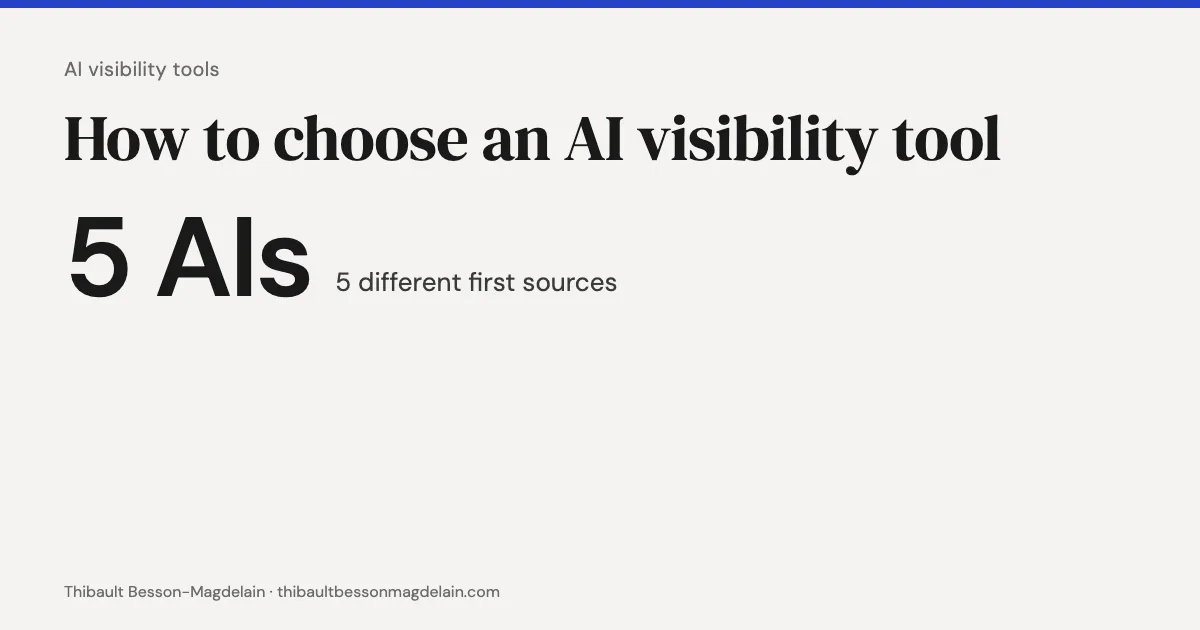
Because each AI builds its answers on different sources, so your visibility in one tells you little about the others. In Sorank's data, the most cited website is sortlist.fr for Grok (7.00 citations per 100 answers), service-public.gouv.fr for ChatGPT (5.98), Trustpilot for Gemini (4.31), pagesjaunes.fr for Claude (3.33) and YouTube for Perplexity (2.15). Five AIs, five different first sources.
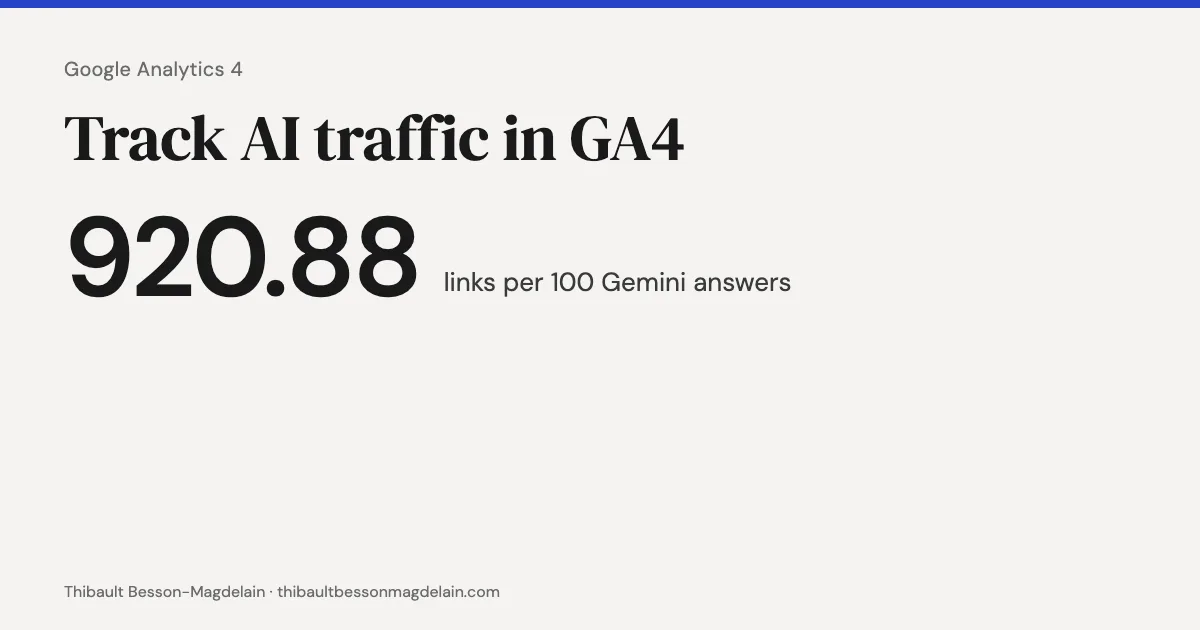
The gaps go beyond the first source. ChatGPT cites Wikipedia 5.40 times per 100 answers and Claude 0.13 times. Gemini gives 920.88 citations per 100 answers in total, Perplexity 273.74. A tool that only covers ChatGPT will tell you nothing about the Gemini half of the market. My rule: track every AI that a meaningful share of your buyers uses, and at least ChatGPT and Gemini.
How often should a tool check the AIs?
Weekly is a good default, monthly is the minimum. AI answers and their sources move fast, and a tool that samples rarely will show you jumps without telling you whether they are real.
Look at the scale of the moves. In the same panel, Gemini went from 365.60 citations per 100 answers in September 2025 to 2,084.84 in February 2026, then 728.03 in October 2026. ChatGPT went from 728.59 in February 2026 to 213.45 in October 2026. Part of this comes from the panel itself (Sorank added industries and questions over time), and part from the models. Either way, a quarterly snapshot would have missed most of it. When you compare tools, ask how many runs per prompt per week they do, not just how many prompts you get.
Which questions should you ask before you buy?
Ask for a trial on your own prompts, not a demo on theirs, and check five things in the raw answers. A vendor confident in its data will let you see it.
- Run 20 of your real buyer questions for two weeks. Compare a few answers with what you see yourself in the AIs.
- Check the sources view. Can you see every URL cited for each answer, and group them by domain?
- Check competitor detection. Did it find brands you had not listed?
- Check languages. If you sell in France and in the UK, are the answers really collected in each market?
- Check what happens next. Does the tool help you act (content, sources to work on, technical checks), or does it only report?
One more point. The research that named this field found that content changes can raise visibility "by up to 40%" in generative engine answers (Aggarwal et al., KDD 2024). A tool is only worth its price if it helps you decide which changes to make.
What do I use, and when would I pick something else?
I use Sorank, because I built it for the way I worked in my agency: AI visibility and Google SEO in the same place, five AIs, sources first. That is an obvious bias, so here is when I would choose differently.
- You have under 20 questions and no budget: do it by hand once a month, plus GA4. No tool needed yet.
- Your team lives in an SEO suite already: try its AI module first, and check model coverage and sources against the grid above.
- You are a large enterprise with a procurement process: you will look at enterprise platforms with dedicated support and security reviews; ask the same six questions anyway.
- You want AI tracking, sources and SEO actions together: that is what Sorank is for. Plans are on the pricing page.
Gartner's Alan Antin summed up why this category exists:
"Generative AI solutions are becoming substitute answer engines, replacing user queries that previously may have been executed in traditional search engines."Alan Antin, VP Analyst, Gartner, February 2024
Whatever you choose, measure the same things every month: presence, share of voice, the sources behind the answers, and what the AIs actually say about you (see what ChatGPT says about your brand).
So, what are the best AI visibility tools?
The best AI visibility tool is the one that covers the AIs your buyers use, runs each of your real questions several times a week, shows every source cited, detects every competitor named, and works in your languages. Start manual if you are small, test any tool on your own prompts before paying, and judge it on its raw data, not on its dashboard.
If you want to test the tool I built against that grid, start with Sorank's AI mention tracking.
Sources
- Gartner, press release, 19 February 2024: search engine volume forecast to drop 25% by 2026; Alan Antin quote.
- Aggarwal et al., "GEO: Generative Engine Optimization", KDD 2024: up to 40% visibility gain.
- Pew Research Center, 25 June 2025: 34% of US adults have used ChatGPT.
- Sorank Data, snapshot of 2 November 2026: first source per AI, monthly citation volumes.
- Sorank Data, methodology: sample and limits.
FAQ
Are there free AI visibility tools?
Yes, in two forms: the manual method (asking the AIs yourself and logging answers in a spreadsheet) and free one-shot checkers offered by many vendors. Both give a snapshot. For trends, competitors and sources over time, you need a paid tool or a lot of hours.
Can an SEO tool track visibility in ChatGPT?
Some SEO suites have added AI visibility modules. Check which AIs they cover, how many times they run each prompt and whether they show every source cited, because depth varies a lot between products.
How much does an AI visibility tool cost?
Prices depend on the number of prompts, AIs, brands and languages tracked, and on how often prompts are run. Compare offers on the same basis: cost per prompt per AI per month, with the same run frequency.
Founder of Sorank, the SEO and GEO platform that tracks how ChatGPT, Gemini, Perplexity, Claude and Grok talk about brands. Before Sorank, I ran an SEO agency that served more than 100 clients. Based in Budapest.
Read next
-
Schema Markup for AI Search: Which Types Matter and Why
What Google and Microsoft say about schema for AI, the 4 types that matter, and JSON-LD you can ship.
-
AI Share of Voice: How to Measure It, With Real Data
The AI share of voice formula, its traps, and real data where the leader changes from one AI to the next.
-
How to Track AI Traffic in GA4: Channel Group and Regex
The exact GA4 setup to see traffic from ChatGPT, Perplexity, Claude and Gemini, and what Google Analytics cannot measure.
Continue on AI visibility: all articles on the blog