AI Search for Restaurants: Which Sites Get You Recommended
When someone asks an AI where to eat tonight, it answers with three to five names and a handful of links. I looked at 7,675 of those answers to see which sites the AIs trust, and what a restaurant owner can actually do about it.
Published · Updated · 11 min read
Contents
- How does AI search pick a restaurant?
- Which sites does AI cite for restaurants?
- Does each AI use the same restaurant guides?
- Can a restaurant's own website get cited?
- Where is Google Maps in AI answers?
- How do you get your restaurant recommended by AI?
- How can you check your restaurant's AI visibility?
- What are the limits of this data?
- FAQ
AI search for restaurants is no longer a curiosity: people now type "where can I have a good dinner near the lake tonight" into ChatGPT or Gemini and get back a short list of names. In France, the telecom regulator Arcep reports that 48% of people now use generative AI, and in the United States 34% of adults had used ChatGPT by early 2025, according to Pew Research Center. A list of five names is brutal for a restaurant: you are on it, or you do not exist for that diner.
Most guides on this topic give the same generic advice. I wanted to see the sources. Sorank, the platform I build, asks the same buyer questions to ChatGPT, Gemini, Perplexity, Claude and Grok every week, and its public dataset on AI citations for restaurants holds 7,675 answers about restaurants collected between July and October 2026. Every figure below comes from the snapshot of 2 November 2026.
How does AI search pick a restaurant?
An AI picks a restaurant by searching the web, reading what guides, review platforms and booking sites say, then naming the places that come up most consistently, with links as proof. It does not taste the food. It trusts the pages that already rank and rate restaurants, so your presence on those pages decides whether you are named.
Concretely, when a model with web access gets a question like "best brunch in Geneva", it runs a few searches, opens a handful of pages, and writes a summary. The links it shows are the pages it relied on. In this dataset, an average restaurant answer carries between 2.85 citations (Perplexity) and 6.91 citations (Gemini). That is a small window: a few guides, a few platforms, sometimes a restaurant website.
This is very close to how local search already worked on Google. Google explains in its own help center that local results are mainly based on relevance, distance and popularity. The AIs add a layer on top: they read the guides and the review platforms that summarize that popularity, then quote them.
Which sites does AI cite for restaurants?
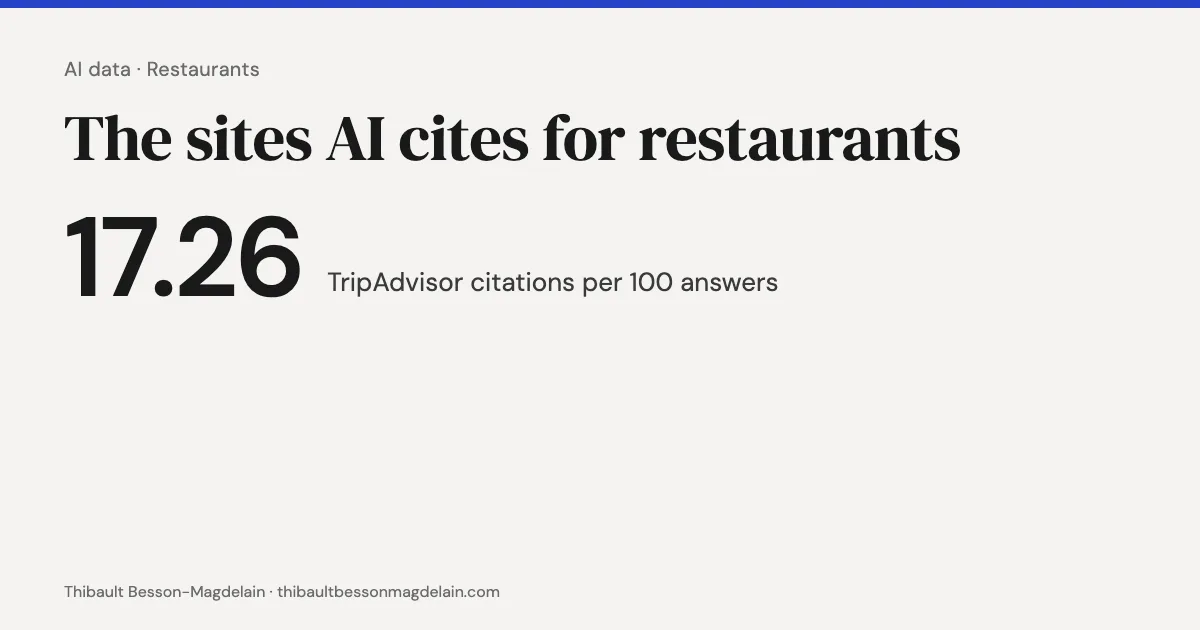
TripAdvisor is the most cited site, with 17.26 citations per 100 answers, far ahead of everything else. Then come a city tourism site (geneve.com, 12.50), the Le Petit Futé guide (8.70), Uber Eats (8.38), TheFork (7.56) and the Michelin Guide (5.07). Restaurant answers lean on four kinds of sources: review platforms, local guides, booking and delivery apps, and official tourism sites.
To put 17.26 in perspective: across all 498,158 answers in the Sorank dataset, the most cited site overall, Trustpilot, gets 2.56 citations per 100 answers. TripAdvisor's weight in restaurants is almost seven times that. If you run a restaurant and you have never looked at your TripAdvisor listing, this is the first thing to fix.
| Type of source | Examples in the data | Citations per 100 answers | What it gives the AI |
|---|---|---|---|
| Review platform | TripAdvisor (+ tripadvisor.be, .ch) | 17.26 | Ratings, volume of reviews, rankings by city |
| Local guide | Le Petit Futé, Michelin Guide | 8.70 / 5.07 | Editorial selection, a trusted third party |
| Delivery app | Uber Eats, Just Eat | 8.38 / 3.91 | Menu, prices, opening hours |
| Booking platform | TheFork (.fr and .ch), Privateaser | 7.56 / 4.91 / 3.23 | Availability, offers, reviews |
| Official tourism or city site | geneve.com, ge.ch | 12.50 / 3.07 | Lists of places endorsed by the city |
| Social network | Facebook, Instagram | 1.98 / 1.06 | Photos, recent activity |
Two details matter. First, the local versions of a platform count: tripadvisor.be (2.06) and tripadvisor.ch (1.71) show up on top of the main domain, so the AI cites the version that matches the diner's country. Second, Reddit is marginal here (0.63), well below Facebook. For restaurants, the conversation that counts is on review and booking platforms, not forums.
Does each AI use the same restaurant guides?
No, and the gap is the biggest I have seen in any industry. Claude cites TripAdvisor 33.88 times per 100 answers, Perplexity 31.43 times, ChatGPT 12.48 times and Gemini only 1.37 times. Gemini builds its answers from Le Petit Futé (14.59), TheFork (10.51), Uber Eats (10.26) and the Michelin Guide (9.25) instead.
Each model has a clear personality on restaurant questions:
- ChatGPT mixes TripAdvisor (12.48) with official tourism sites such as geneve.com (12.44) and ge.ch (5.29), plus delivery apps (Just Eat 6.46, Uber Eats 5.90).
- Gemini reads guides and booking sites: Le Petit Futé, TheFork, Michelin, Privateaser (6.18). It is also the AI that cites the most links per answer (6.91).
- Perplexity leans on TripAdvisor, then Uber Eats (10.86), and is the only one that cites Instagram regularly (4.11).
- Claude is the most TripAdvisor-dependent (33.88 on the main domain, plus 22.35 on tripadvisor.be and 12.71 on tripadvisor.ch), and also cites PagesJaunes (9.18), the French yellow pages.
- Grok only has 125 answers in this industry, so treat its figures as indicative: it cites geneve.com and TripAdvisor heavily.
My take: "optimizing for AI" means nothing if you do not know which AI your diners use. A restaurant that only works on its Michelin and TheFork presence will look good in Gemini and almost absent in Claude, and the reverse is true for a restaurant that only polishes TripAdvisor.
Can a restaurant's own website get cited?
Yes, and this is the good news of this dataset. Four restaurants' own websites appear in the 20 most cited domains: chezphilippe.ch (3.00), caveduboucher.ch (2.70), tacos-tacos.ch (2.08) and lacrepeduperegege.fr (1.68). In most industries, the AI quotes what others say about a business. In restaurants, a clear website can be quoted directly.
Why? Because restaurant questions are concrete. "Is it open on Sunday", "do they have a vegetarian menu", "can I book for 12 people": the best answer is often on the restaurant's own page, if the page states it in plain text. A menu hidden in a PDF or an image gives the AI nothing to read.
What a quotable restaurant website looks like:
- The menu in HTML text, with dish names and prices, not only a PDF.
- Opening hours, address and phone in text on every page, identical to your listings.
- A short "about" block that answers the questions diners ask: cuisine type, price range, terrace, private room, groups, dietary options.
- Structured data: Google documents the LocalBusiness structured data, with Restaurant as a type and properties like menu and servesCuisine. It helps machines read the basics without guessing.
Where is Google Maps in AI answers?
Not in the links. No Google domain (Maps or Business Profile) appears among the 37 most cited domains on restaurant questions. That does not mean your Google listing is useless: it remains the base of local search on Google, and AIs that search the web find the same reviews and ratings through other pages. It means the links AIs show to back a restaurant point elsewhere.
So keep your Google Business Profile complete and active, because Google itself says that "more reviews and positive ratings can help your business's local ranking" (Google Business Profile Help). But do not stop there. The pages that AIs actually cite are TripAdvisor, the guides, the booking and delivery apps, and the tourism office of your city. That is where the second half of the work is.
How do you get your restaurant recommended by AI?
You get recommended by being present, consistent and well rated on the five or six sources the AIs already cite in your city, and by making your own website easy to quote. Here is the order I would follow.
- Claim and complete TripAdvisor. It is the first source of ChatGPT, Perplexity and Claude. Photos, hours, menu link, and replies to reviews.
- Get listed in the guides of your area. Le Petit Futé, Michelin if it is realistic, local food blogs, and above all your city's tourism site: geneve.com alone gets 12.50 citations per 100 answers.
- Be on one booking and one delivery platform if it fits your model. TheFork and Uber Eats are both cited by ChatGPT, Gemini, Perplexity and Claude.
- Keep the same facts everywhere. Name, address, phone, hours, cuisine. When two sources disagree, the AI has a reason to skip you.
- Make your website quotable (see above): text menu, hours, answers to diners' questions, structured data.
- Collect reviews that describe something. "Best fondue in Carouge" is easier for an AI to reuse than "great, thanks". The Princeton researchers who named generative engine optimization showed that adding quotations and statistics to a source can raise its visibility in AI answers by up to 40% (Aggarwal et al., KDD 2024).
If you want the list of sources for your exact city and cuisine rather than my general picture, the restaurant study linked at the top of this article is a good start, and the Sorank page for restaurants explains how the tracking works for a single venue or a group.
How can you check your restaurant's AI visibility?
Ask the AIs the questions your diners ask, and write down two things: the restaurants named and the links given. One hour is enough for a first picture.
- Write 10 diner questions. "Best Italian restaurant in [neighborhood]", "restaurant with a terrace for 10 people in [city]", "where to eat late on Sunday in [city]". Not your name: the questions of people who do not know you yet.
- Ask each AI. ChatGPT, Gemini, Perplexity, Claude and Grok, in a fresh session, with web search on.
- Record names and domains. After 50 answers, you will see the same five or six sites coming back. Those are your city's sources.
- Compare with your presence. For each recurring site: are you listed, is the listing complete, are the reviews recent?
- Repeat every month. TripAdvisor's weight in this panel went from 23.79 citations per 100 answers in July 2026 to 10.32 in September and back to 17.09 in October. One test proves nothing; a series does.
By hand, this works for a few questions. For dozens of questions, five AIs and a weekly history, I built AI mention tracking in Sorank (plans on the pricing page). For the bigger picture across industries, read which sources AI cites, my guide to business directories in AI search and the basics of local SEO.
What are the limits of this data?
This is a panel of real buyer questions tracked for Sorank clients, not a census of every restaurant search. Keep these limits in mind before drawing conclusions for your own city.
- Geography. The panel is French-speaking for the most part (7,600 answers in French, 801 in English), with a lot of Geneva, France and Belgium. That is why geneve.com ranks so high. In English, the leader is michelin.com (10.24), then Uber Eats (4.99) and TripAdvisor (4.37).
- Period. Industry classification starts in July 2026, so restaurant figures cover four months.
- Samples by AI. ChatGPT and Gemini 2,475 answers each, Perplexity 1,750, Claude 850, Grok 125 (indicative only).
- Unit. Citations per 100 answers, not a share of answers: one answer can cite the same site several times for several restaurants.
So, how does AI search work for restaurants?
AI search recommends the restaurants that TripAdvisor, local guides, booking apps and tourism sites already vouch for, and each AI reads a different mix of them. TripAdvisor leads with 17.26 citations per 100 answers, Gemini prefers guides like Le Petit Futé and Michelin, and a restaurant with a clear, text-based website can be cited directly. Fix your presence on the sources of your city, keep your facts consistent, then measure every month.
The quickest way to know where you stand is to see what the five AIs answer about your city this month. Track your restaurant's AI mentions with Sorank.
Sources
- Sorank Data, AI citation study: restaurants, snapshot of 2 November 2026: every restaurant figure in this article.
- Sorank Data, all industries: the 2.56 overall rate for Trustpilot and the 498,158 answers.
- Google Business Profile Help, "Tips to improve your local ranking on Google": relevance, distance and popularity.
- Google Search Central, LocalBusiness structured data: Restaurant type, menu and servesCuisine properties.
- Aggarwal et al., "GEO: Generative Engine Optimization", KDD 2024: up to 40% visibility gain.
- Arcep, digital barometer, February 2026: 48% of people in France use generative AI.
- Pew Research Center, 25 June 2025: 34% of US adults have used ChatGPT.
FAQ
How do I get my restaurant on ChatGPT?
Be present and complete on the sites ChatGPT already cites for restaurants: TripAdvisor (12.48 citations per 100 answers in this dataset), your city's tourism site, delivery and booking apps, and the Michelin Guide if relevant. Then make sure your own website lists the menu, hours and address in plain text. There is no form to submit a restaurant to ChatGPT.
Does ChatGPT use Google reviews for restaurants?
In this dataset, no Google domain appears among the 37 most cited sites on restaurant questions. ChatGPT may read information that also appears on Google, but the links it shows point to TripAdvisor, tourism sites, delivery apps and guides. Keep your Google listing up to date anyway: it is still the base of local search.
Which AI recommends restaurants the most differently?
Gemini. It cites TripAdvisor only 1.37 times per 100 answers, against 33.88 for Claude, and relies on Le Petit Futé, TheFork, Uber Eats and the Michelin Guide instead. A restaurant needs both kinds of presence to show up in every AI.
Founder of Sorank, the SEO and GEO platform that tracks how ChatGPT, Gemini, Perplexity, Claude and Grok talk about brands. Before Sorank, I ran an SEO agency that served more than 100 clients. Based in Budapest.
Read next
-
AI Search in Real Estate: Which Sources AIs Cite, and Who They Recommend
On 14,855 real estate questions, AIs cite government sites and PagesJaunes far more than property portals.
-
AI Search for SaaS: Your Own Website Beats G2
Across 26,668 AI answers about software, vendors' own sites are cited far more than G2, and Capterra is absent.
-
AI Search for Lawyers: What AIs Cite When People Ask Legal Questions
On 10,509 legal questions, AIs cite government sites first, then law firm websites and bar associations.
Continue on AI visibility: all articles on the blog