AI Search for Lawyers: What AIs Cite When People Ask Legal Questions
When someone asks an AI about a legal problem, it quotes the law first and names lawyers second. Here is which sources it uses, how each AI differs, and what a law firm can do about it.
Published · Updated · 9 min read
Contents
- What do AIs cite on legal questions?
- Why do AIs quote official sites first?
- Do AIs cite law firm websites?
- Which AI is most likely to name a lawyer?
- Do reviews and big platforms matter for lawyers?
- How can a law firm get cited by AI?
- What are the ethical limits for lawyers?
- What are the limits of this data?
- FAQ
AI search for lawyers works differently from AI search for a restaurant or a plumber. When someone asks ChatGPT "can I get compensation for a delayed flight?" or "how do I contest a parking fine?", the AI first explains the law with an official link, and only then names a firm, if it names one at all. I looked at the 10,509 legal answers in Sorank's dataset, collected from ChatGPT, Gemini, Perplexity, Claude and Grok between July and October 2026, to see exactly which sources they use. This is not a side topic anymore: 34% of US adults had used ChatGPT by early 2025, according to Pew Research Center, and legal questions are exactly the kind people ask before calling anyone.
The figures below come from the public dataset on sorank.com/data and its legal services study, snapshot of 2 November 2026. The panel is mostly French-speaking, so French official sites dominate; I also point out what this means for firms in English-speaking markets.
What do AIs cite on legal questions?
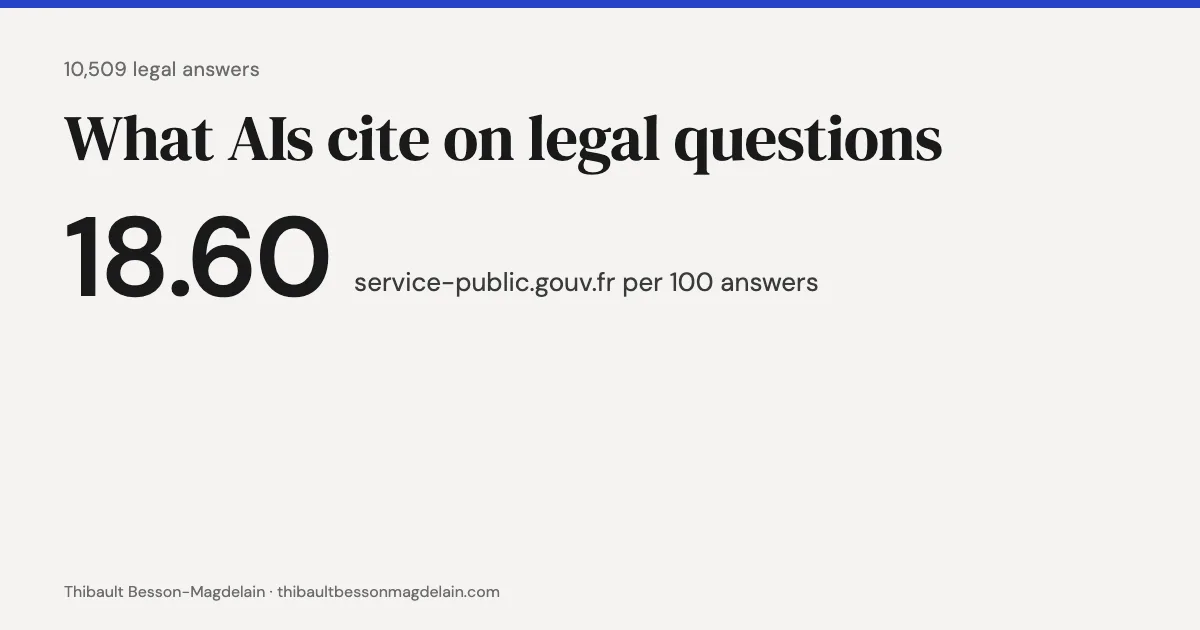
Government sites first, by far. service-public.gouv.fr is cited 18.60 times per 100 legal answers, followed by ecologie.gouv.fr (7.36), aviation-civile.gouv.fr (5.35), economie.gouv.fr (5.25) and the Paris bar association, avocatparis.org (5.24). Six of the top ten are public bodies, including europa.eu (4.68) and justice.fr (4.61).
Grouped by type, the top 50 legal sources split into five families. Public bodies (14 sites) add up to 56.89 citations per 100 answers. Flight compensation and mediation services such as AirHelp and the travel mediator (8 sites) add up to 16.41, because the panel includes many questions about delayed flights. Law firm websites (16 sites) reach 15.82, bar associations 11.91 and legal platforms like Justifit 6.22. In other words, a firm's own site is cited more often in legal than in most industries, but it still comes after the law itself.
Why do AIs quote official sites first?
Because a legal answer has to state a rule before it can recommend a person, and official sites are the most verifiable statement of the rule. service-public.gouv.fr gets 18.60 citations per 100 legal answers, against 2.36 across all industries: almost eight times more. The same logic explains europa.eu and eur-lex.europa.eu (European consumer law, flight compensation rules) and, in English answers, nycourts.gov (0.80) and njcourts.gov (0.78).
There is also a safety reason. General AI models are known to get law wrong. A Stanford RegLab and Institute for Human-Centered AI study found that:
"Hallucination rates range from 69% to 88% in response to specific legal queries for state-of-the-art language models."Dahl, Magesh, Suzgun and Ho, "Hallucinating Law", Stanford HAI, January 2024
Anchoring an answer on an official page is how the assistants reduce that risk. For a law firm, the consequence is simple: you will rarely be the first link. You can be the name that comes right after.
Do AIs cite law firm websites?
Yes, more than in most sectors. Sixteen law firm websites are in the top 50 legal sources, led by politanoavocat.fr (3.55 per 100 answers), avocats-lacombe-brisou.fr (2.85) and kohenavocats.com (1.82), plus US personal injury firms such as brandonjbroderick.com (0.80). In most other industries, the top 50 is dominated by platforms and directories, not by the providers' own sites.
One honest caveat: the panel includes law firms whose visibility Sorank tracks, and the questions are built around their practice areas, which helps their sites appear. Still, the pattern makes sense. A legal question is specific ("contest a dismissal in Toulon", "personal injury after a car crash in New Jersey"), and a firm page that answers that exact question, with the local rule and the procedure, is a good source. Generic "our practice areas" pages are not.
| AI | Legal answers | 1st source | 2nd source | 3rd source | Cites firm sites in its top 8? |
|---|---|---|---|---|---|
| ChatGPT | 2,853 | service-public.gouv.fr (27.34) | europa.eu (14.13) | justice.fr (13.56) | No |
| Gemini | 2,853 | service-public.gouv.fr (23.27) | airhelp.com (11.85) | europe-consommateurs.eu (11.11) | No (bar association 4th) |
| Perplexity | 2,232 | service-public.gouv.fr (5.47) | consultation.avocat.fr (5.06) | politanoavocat.fr (3.81) | Yes, 5 of 8 |
| Claude | 1,596 | air-indemnite.com (7.27) | justifit.fr (5.33) | vol-retarde.fr (4.39) | Yes, 3 of 8 |
| Grok | 975 | service-public.gouv.fr (42.87) | economie.gouv.fr (35.08) | airhelp.fr (18.15) | Yes, 1 of 8 |
Which AI is most likely to name a lawyer?
Perplexity and Claude. Both put law firm websites and lawyer platforms high in their sources, while ChatGPT, Gemini and Grok lean on official sites. In Perplexity, the national bar's lawyer search, consultation.avocat.fr, is the second source (5.06) and five of the top eight sources are firm websites. In Claude, service-public.gouv.fr is not even in the top 30 (below 0.63); Claude cites claim services, the Justifit platform (5.33), kohenavocats.com (4.01), a US injury firm and the StarOfService directory (3.38).
ChatGPT is the most "institutional": its top eight legal sources are official sites and bar associations, with avocatparis.org (8.13) and barreautoulon.fr (8.24) as the only professional sources. Grok goes even further toward official sites (42.87 per 100 answers for service-public.gouv.fr), but on a smaller sample of 975 answers. My reading: if you want to be named, Perplexity and Claude are where a firm's own content counts the most; in ChatGPT and Gemini, being listed correctly by your bar association matters more than your blog. Sorank's Claude rank tracker shows this model on its own.
Do reviews and big platforms matter for lawyers?
Very little, in this data. Across July to October 2026, Trustpilot peaked at 1.47 citations per 100 legal answers (July) and fell to 0.03 in October. Wikipedia never went above 0.61, YouTube above 0.86, Reddit above 0.25. LinkedIn stayed between 0.12 and 0.32.
That does not mean reviews are useless for a law firm: they still matter on Google and on your Google Business Profile. It means that when the AI justifies a recommendation on a legal question, it prefers an official page, a bar listing, a specialized platform or the firm's own explanation over a star rating. The lawyer directories it does use are the institutional ones (bar associations, consultation.avocat.fr) and a few platforms like Justifit and Alexia. More on directories in business directories in AI search.
How can a law firm get cited by AI?
Write the page that answers the exact legal question, make sure official and professional listings are correct, and measure. The firms that show up are the ones whose pages explain a specific procedure, locally, better than a generic site.
- One page per real question. "How to contest a dismissal for serious misconduct", "compensation after a flight delay over 3 hours". State the rule, cite the official text with a link, give the steps, the deadlines and when a lawyer is needed.
- Link to the official sources yourself. The AIs trust official sites; a page that cites them precisely is easier to trust and to quote alongside them.
- Get your bar listing right. Name, address, practice areas and languages on your bar association's directory. In ChatGPT and Gemini, bar sites are among the few professional sources cited.
- Be consistent everywhere. Same firm name, address and practice areas on your site, your Google profile, lawyer platforms and directories. Structured data (LegalService, Attorney, Person) helps machines read it; see schema markup for AI search.
- Measure per AI and per practice area. Ask the questions your clients ask, in each AI, every month, and check whether your firm is named and which page is linked. That is what Sorank does for law firms (plans on the pricing page). You can also check what the AIs say about your firm by name; I explain how in what ChatGPT says about your brand.
What are the ethical limits for lawyers?
Everything you publish to get cited is still lawyer communication, and the advertising rules of your bar apply. In the US, each state adopts its own version of the ABA Model Rules; California's Chapter 7, "Information about legal services", is a typical example: communications must not be false or misleading. In France, article 10 of the national bar rules (RIN) frames lawyer communication and requires announced practice areas to match real, regular practice.
In practice: no invented results, no "best lawyer in town" claims you cannot back, no client testimonials where your jurisdiction forbids them, and no fake reviews. Clear, accurate legal explanations are both what the rules allow and what the AIs cite.
What are the limits of this data?
The legal sample is 10,509 answers over four months (July to October 2026), with a mix of questions that reflects the websites Sorank tracks.
- Topic mix. Many questions are about flight compensation, which explains AirHelp, Flightright and the civil aviation authority in the top 20.
- Mostly French-speaking. US firms and courts appear (New York, New Jersey), but French official sites dominate.
- Grok sample. 975 legal answers: solid enough to show a direction, not to rank small sources.
- Unit. Citations per 100 answers, not a share of answers. The methodology page gives the details.
So, what do AIs cite when people ask legal questions?
Official sites first (service-public.gouv.fr at 18.60 citations per 100 legal answers), then specialized services, law firm websites and bar associations, with almost no weight for reviews or big platforms. Perplexity and Claude are the most likely to cite a firm's own pages; ChatGPT and Gemini stay institutional. A firm that publishes precise, local answers to real legal questions, keeps its bar listing accurate and measures each AI has a real chance of being the name after the law.
To see whether the AIs name your firm on your practice areas, start with Sorank for lawyers.
Sources
- Sorank Data, legal services AI citation study, snapshot of 2 November 2026: every citation figure in this article.
- Sorank Data, methodology: sample, exclusions and limits.
- Dahl, Magesh, Suzgun and Ho, "Hallucinating Law: Legal Mistakes with Large Language Models are Pervasive", Stanford HAI, 11 January 2024: 69% to 88% hallucination rates on legal queries.
- State Bar of California, Rules of Professional Conduct, Chapter 7: rules on information about legal services.
- Pew Research Center, 25 June 2025: 34% of US adults have used ChatGPT.
FAQ
Does ChatGPT recommend lawyers?
Sometimes, but it explains the law first. On legal questions in this dataset, ChatGPT's top sources are official sites such as service-public.gouv.fr (27.34 citations per 100 answers), europa.eu and justice.fr. The professional sources it cites most are bar associations, like the Paris bar (8.13).
How do I get my law firm mentioned by AI?
Publish precise pages that answer real client questions, with the rule, the official source, the procedure and the local context. Keep your bar listing and your profiles consistent, and check every month whether ChatGPT, Gemini, Claude, Perplexity and Grok name your firm on your practice areas.
Is it allowed for lawyers to optimize for AI search?
Yes, within the advertising rules of your bar. Accurate, non-misleading information is allowed and encouraged; invented results, unverifiable superlatives and fake reviews are not. Check your own jurisdiction's rules before publishing.
Founder of Sorank, the SEO and GEO platform that tracks how ChatGPT, Gemini, Perplexity, Claude and Grok talk about brands. Before Sorank, I ran an SEO agency that served more than 100 clients. Based in Budapest.
Read next
-
AI Citation Trends: What 15 Months of AI Answers Show
Wikipedia fell from 11.31 to 0.12 citations per 100 AI answers in a year: 15 months of trends.
-
AI Search in Real Estate: Which Sources AIs Cite, and Who They Recommend
On 14,855 real estate questions, AIs cite government sites and PagesJaunes far more than property portals.
-
AI Answers in French vs English: Why the Sources Are Not the Same
French AI answers cite government sites and directories; English ones cite Amazon, Reddit and brand websites.
Continue on AI visibility: all articles on the blog