AI Answers in French vs English: Why the Sources Are Not the Same
Ask ChatGPT the same kind of question in French and in English and it will not lean on the same websites. Here is how the sources differ, model by model, and what it means if you sell in both languages.

Published · Updated · 9 min read
Contents
- Do AI answers in French and English cite the same sources?
- Why do French answers cite so many government sites?
- Which platforms gain in English?
- Does each AI switch sources with the language?
- Are English answers more spread out?
- Why does the language change the sources?
- What should you do if you sell in both languages?
- What are the limits of this comparison?
- FAQ
AI answers in French vs English do not draw on the same web. I compared 435,183 answers given for French-speaking markets with 59,825 answers for English-speaking ones, all collected by Sorank from ChatGPT, Gemini, Perplexity, Claude and Grok between August 2025 and October 2026. The gap is not a detail: the first source changes, the type of source changes, and even the number of different websites cited changes. It also makes sense once you look at the raw material. According to W3Techs, 49.5% of websites with a known content language are in English, and 4.6% in French.
If you sell in both languages, this matters a lot. With 34% of US adults having used ChatGPT by early 2025 (Pew Research Center), English-speaking buyers already ask AI for suppliers, and the sources they get are not the ones a French buyer gets. All figures below come from the public dataset on sorank.com/data, snapshot of 2 November 2026, and its French vs English study.
Do AI answers in French and English cite the same sources?
No. French answers lean on official and reference sites, English answers on marketplaces, communities and brand websites. In French, the top 5 is service-public.gouv.fr and Trustpilot (2.69 citations per 100 answers each), Wikipedia (2.26), economie.gouv.fr (2.08) and pagesjaunes.fr (2.03). In English, it is Amazon (2.51), Trustpilot (1.70), ftc.gov (1.13), YouTube and Reddit (1.06 each).
| Source | Type | French answers | English answers | Gap |
|---|---|---|---|---|
| Trustpilot | Review platform | 2.69 | 1.70 | 1.6x more in French |
| Wikipedia | Encyclopedia | 2.26 | 0.93 | 2.4x more in French |
| YouTube | Video | 1.66 | 1.06 | 1.6x more in French |
| pagesjaunes.fr | Directory | 2.03 | < 0.15 | French only |
| Amazon | Marketplace | 0.67 | 2.51 | 3.7x more in English |
| Forum | 0.36 | 1.06 | 2.9x more in English | |
| WordPress | Software | < 0.11 | 0.95 | English only |
| GitHub | Code platform | < 0.11 | 0.93 | English only |
Only Trustpilot is near the top in both languages. Everything else moves. A brand that plans its AI visibility in one language and translates the plan for the other is working from the wrong map.
Why do French answers cite so many government sites?
Because French buyer questions often touch rules, and France has a dense set of official sites that answer them. Eleven of the top 50 French sources are public bodies (service-public.gouv.fr, economie.gouv.fr, legifrance.gouv.fr, cnil.fr, anj.fr, ameli.fr and others), together worth 9.20 citations per 100 answers. In English, only four public sites make the top 50 (ftc.gov, gov.uk and two US National Institutes of Health sites), worth 2.29.
When a French user asks how to choose an accountant, a builder or a training provider, the AI first explains the legal frame (registration, guarantees, public aid) and links the official page, then names companies. ChatGPT is the strongest case: in French, its top three sources are service-public.gouv.fr (6.89), Wikipedia (5.89) and economie.gouv.fr (4.96). My take: in France, a business that is listed correctly in official registers and mentioned on public sites (labels, certifications, approved provider lists) has an edge that has no real equivalent in English.
Which platforms gain in English?
Amazon, Reddit, GitHub, WordPress and booking platforms all weigh more in English. Amazon is the first English source (2.51 per 100 answers, against 0.67 in French). Reddit is cited about three times more (1.06 against 0.36). WordPress (0.95), GitHub (0.93) and booking.com (0.87) are in the English top 10 and absent from the French top 50.
Part of this is the question mix: the English panel has many software, e-commerce and coworking questions, which explains woocommerce.com, stripe.com, cloudflare.com or regus.com in the top 50. Part of it is real: English-speaking communities produce far more forum threads and reviews, and the AIs use them. If Reddit is in your plan, it belongs in the English plan first; I go further in Reddit and AI citations.
Does each AI switch sources with the language?
Yes, all of them. ChatGPT moves from service-public.gouv.fr (6.89) in French to ftc.gov (4.27) in English. Gemini moves from Trustpilot (4.80) to YouTube (2.22). Perplexity moves from YouTube (2.20) to Reddit (2.18). Claude moves from pagesjaunes.fr (3.78) to Amazon (2.02).
The logic stays the same inside each model, only the local equivalent changes. ChatGPT reaches for the official consumer authority in both cases (the French administration, the US Federal Trade Commission). Claude reaches for a list of providers: a directory in French, a marketplace in English. Grok is the exception I cannot read reliably: with only 1,381 English answers, its English top list (WordPress at 18.25 per 100 answers) reflects a few repeated questions more than a habit, so treat it as indicative. For the model-level detail, see ChatGPT's sources and Perplexity's sources.
Are English answers more spread out?
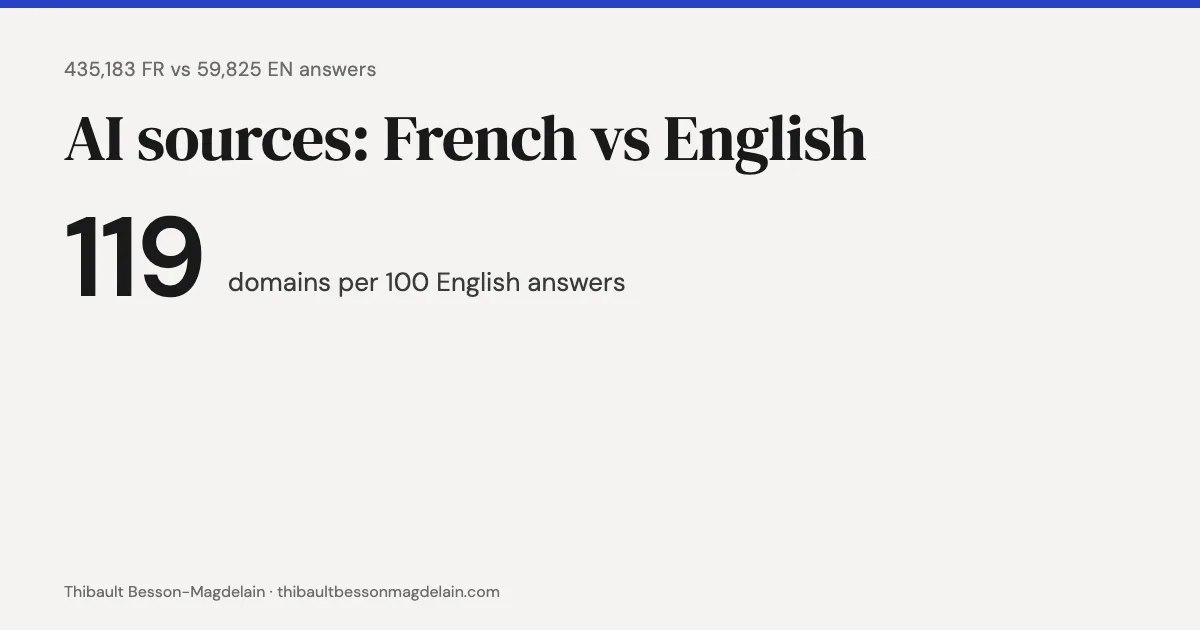
Yes, much more. English answers cite 119 different domains per 100 answers, French answers 33. The English dataset has 71,365 distinct domains for 59,825 answers; the French one 145,385 domains for 435,183 answers. The top 10 also weighs less in English (12.19 citations per 100 answers in total) than in French (17.96).
The comparison is conservative: a smaller sample usually shows fewer distinct domains, not more, so the real gap is probably at least this large. In practice, French AI visibility is a game of a few big sources (get on them and you are covered), while English AI visibility is a long tail of niche sites, blogs and brand pages. That makes English harder to cover with a short list, and makes your own website relatively more important.
Why does the language change the sources?
Because the AIs search the web in the language of the question, and the web is not the same in each language. Researchers have measured this directly:
"LLMs displayed systemic bias towards information in the same language as the query language."Sharma, Murray and Xiao, "Faux Polyglot: A Study on Information Disparity in Multilingual Large Language Models", NAACL 2025
A second study on multilingual retrieval, "Linguistic Nepotism" (Ki et al., 2025), found that models preferentially cite English sources when the query is in English, even when other documents are just as relevant. Add the size gap (49.5% of websites in English against 4.6% in French) and the different institutions of each country, and you get two distinct source maps. The French one is narrower and more official; the English one is wider and more commercial.
What should you do if you sell in both languages?
Build one source plan per language, based on what the AIs actually cite in each market, not one plan translated twice.
- Write buyer questions natively in each language. Not translations: the questions a French and an English buyer really ask, with local terms.
- List the sources per language. Ask them to ChatGPT, Gemini, Perplexity, Claude and Grok and note the cited domains. In French, expect official sites, directories and Trustpilot; in English, marketplaces, forums, review sites and niche blogs.
- Cover the short French list fully. A complete PagesJaunes profile, a Trustpilot page with recent reviews, correct entries on official registers, a Wikipedia mention if you meet its rules.
- Make your English pages quotable. Because English answers are spread across many sites, your own site gets cited more often there: clear answers, comparison tables, prices, sourced numbers.
- Track each language separately. A global "AI visibility score" mixing both hides the differences. Sorank's AI visibility tracker runs each market with its own questions (plans on the pricing page).
The general ranking of sources across both languages is in which sources AI cites.
What are the limits of this comparison?
The two samples are not the same size and not the same questions. French answers outnumber English ones seven to one, and each side reflects the industries of the websites Sorank tracks.
- Different question mix. The English panel leans toward software, e-commerce, coworking and health products; the French one toward local services, agencies and regulated trades.
- Small English samples for some models. Claude has 6,385 English answers and Grok 1,381. Read Grok's English figures as indicative.
- A gap in the English series. Answers about Sorank's own market are removed, which empties the English monthly series from February to June 2026. Totals are not affected beyond that.
- Unit. Citations per 100 answers, not a share of answers. The methodology page gives the details.
So, do AI answers in French and English cite the same sources?
No: French answers rely on public bodies, Trustpilot, Wikipedia and directories like PagesJaunes, while English answers rely on Amazon, Reddit, platforms and a much longer tail of niche and brand websites. Every AI switches its first source with the language. If you sell in both, you need two source plans and two measurements.
To see which sources the AIs use for your brand in each market, start tracking your AI mentions with Sorank.
Sources
- Sorank Data, French vs English AI citation study, snapshot of 2 November 2026: every citation figure in this article.
- Sorank Data, methodology: samples, exclusions and limits.
- Sharma, Murray and Xiao, "Faux Polyglot", NAACL 2025: same-language bias in retrieval and generation.
- Ki et al., "Linguistic Nepotism: Trading-off Quality for Language Preference in Multilingual RAG", 2025: preference for English sources on English queries.
- W3Techs, usage of content languages for websites: 49.5% English, 4.6% French (accessed 8 November 2026).
- Pew Research Center, 25 June 2025: 34% of US adults have used ChatGPT.
FAQ
Does ChatGPT give different answers in French and English?
Yes, and it cites different sources. In this dataset, ChatGPT's first source is service-public.gouv.fr (6.89 citations per 100 answers) in French and ftc.gov (4.27) in English. It also cites Amazon far more in English (4.12) than in French, where Amazon is not even in its top 30 (under 0.22).
Is it better to ask AI in English?
Not if you want local answers. English answers draw on a wider and more commercial web, while French answers lean on official French sources and directories. For a question about a French supplier or French rules, asking in French usually gets you more relevant local sources.
Do I need a separate GEO strategy for each language?
Yes. GEO (generative engine optimization) depends on the sources each AI cites, and those sources change with the language. Build one list of target sources per market, written from native buyer questions, and measure each language separately.
Founder of Sorank, the SEO and GEO platform that tracks how ChatGPT, Gemini, Perplexity, Claude and Grok talk about brands. Before Sorank, I ran an SEO agency that served more than 100 clients. Based in Budapest.
Read next
-
AI Citation Trends: What 15 Months of AI Answers Show
Wikipedia fell from 11.31 to 0.12 citations per 100 AI answers in a year: 15 months of trends.
-
AI Search for Lawyers: What AIs Cite When People Ask Legal Questions
On 10,509 legal questions, AIs cite government sites first, then law firm websites and bar associations.
-
AI Search in Real Estate: Which Sources AIs Cite, and Who They Recommend
On 14,855 real estate questions, AIs cite government sites and PagesJaunes far more than property portals.
Continue on AI visibility: all articles on the blog