Business Directories in AI Search: Which Ones AI Actually Cites
Directories are back. Claude's most cited website is PagesJaunes, Grok's is Sortlist, and ChatGPT barely uses either. Here is what the data says, and which listings are worth your time.

Published · Updated · 11 min read
Contents
- Which business directories do AIs cite the most?
- Does each AI use the same directories?
- Why do AI assistants trust directories?
- Which directories matter in your industry?
- Which directories matter in English-speaking markets?
- Which directories should you be listed in?
- How do you optimize a directory listing for AI?
- Which directory offers should you avoid?
- How do you check that your listings work?
- FAQ
Business directories in AI search were supposed to be dead. They are not. When I went through the 498,158 answers that Sorank collected from ChatGPT, Gemini, Perplexity, Claude and Grok between August 2025 and October 2026, a French directory, PagesJaunes, came out as the fifth most cited website overall and the very first source of Claude. That matters because people now ask AI before they open a search engine: 34% of US adults had used ChatGPT by early 2025, according to Pew Research Center, about double the share of 2023.
When someone asks an AI for "a good electrician near me" or "a web agency for a small shop", the AI needs lists of real providers with addresses and ratings. Directories are exactly that. In this article I use the public dataset on sorank.com/data (snapshot of 2 November 2026) to show which directories each AI cites, in which industries they weigh the most, and which listings I would actually pay attention to. Most of the panel is French-speaking, so the French directories are over-represented; I flag the English-speaking picture separately.
Which business directories do AIs cite the most?
Across the five models, the most cited directory is pagesjaunes.fr, with 1.78 citations per 100 answers (8,855 citations, 5th website overall). Next come the agency directory sortlist.fr (1.28, 7th), the software comparison site tool-advisor.fr (0.88, 10th) and the web agency directory lafabriquedunet.fr (0.58). Only Trustpilot, two government sites and Wikipedia are cited more often than PagesJaunes.
To put that in perspective: PagesJaunes is cited more than YouTube (1.72), Shopify (1.27) or Amazon (0.94) on business questions. A citation here means a web address given by the AI to back a company it recommends, and the unit is citations per 100 answers, not a share of answers.
| Directory | Type | All AIs | ChatGPT | Gemini | Perplexity | Claude | Grok |
|---|---|---|---|---|---|---|---|
| pagesjaunes.fr | General business directory | 1.78 | < 0.19 | 3.45 | < 0.17 | 3.33 | 1.38 |
| sortlist.fr | Agency directory | 1.28 | < 0.19 | 1.55 | 1.05 | 1.65 | 7.00 |
| tool-advisor.fr | Software comparison | 0.88 | < 0.19 | 1.68 | 1.01 | < 0.23 | 2.37 |
| lafabriquedunet.fr | Web agency directory | 0.58 | 0.55 | 0.57 | 0.56 | 0.59 | 1.01 |
| codeur.com | Freelance marketplace | 0.36 | < 0.19 | 0.86 | < 0.17 | < 0.23 | < 0.71 |
| europages.fr | B2B supplier directory | n/a | < 0.19 | < 0.30 | < 0.17 | 0.66 | < 0.71 |
The pattern is clear: general directories win on local trades, specialized directories win on B2B services. lafabriquedunet.fr is the odd one out, with a similar rate in all five models, which makes it one of the few "safe" listings if you sell web services in France.
Does each AI use the same directories?
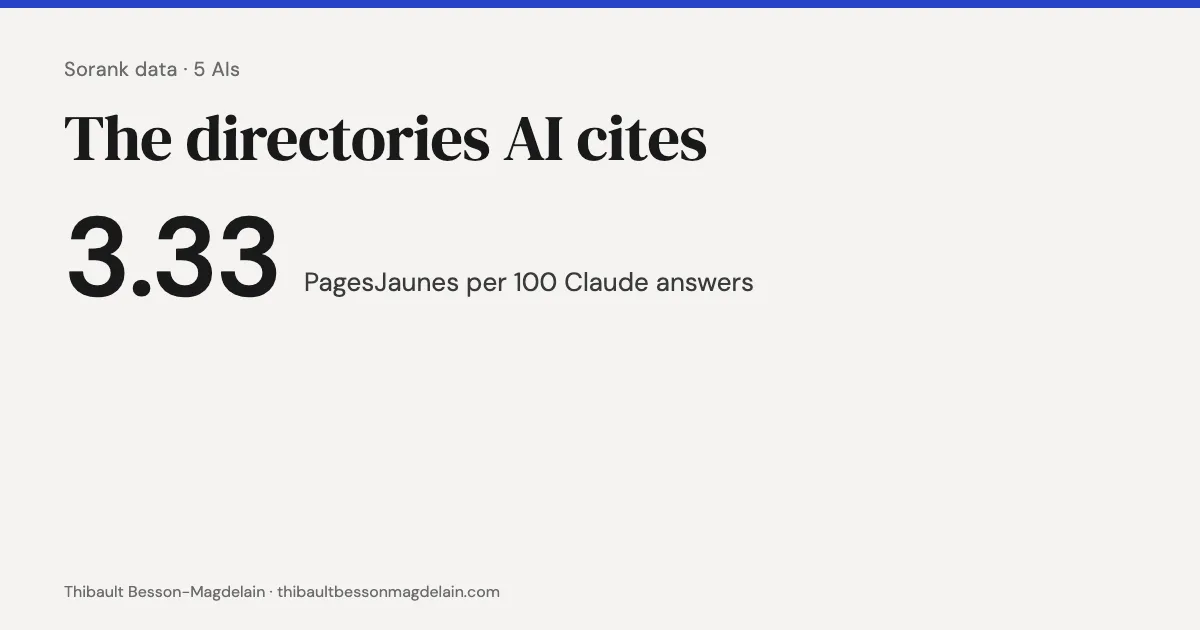
No. Claude and Gemini lean heavily on PagesJaunes, Grok on Sortlist, and ChatGPT on neither. Claude cites pagesjaunes.fr 3.33 times per 100 answers, five times more than Trustpilot (0.66) in the same model. Grok cites sortlist.fr 7.00 times per 100 answers, its single most cited website. ChatGPT, by contrast, prefers official sources such as service-public.gouv.fr (5.98) and Wikipedia (5.38).
This changes how you prioritize. If your buyers use Claude, a complete PagesJaunes profile is probably the single best listing you can have. I go deeper into that model in my article on the sources Claude uses. If they use Grok, being on Sortlist, with reviews, matters more; see Grok's sources. Sorank tracks both models separately, for example with its Claude rank tracker.
One caution on Sortlist: its rate peaked in February 2026 (11.45 per 100 answers in the monthly ranking) and it dropped out of the monthly top list from July 2026, when the panel grew from about 23,000 to 66,000 answers a month and the mix of industries changed. Part of its overall weight comes from early months where marketing agencies were a large share of the questions. PagesJaunes, on the other hand, stayed in the monthly top list every month from January to October 2026, between 1.27 and 4.27 per 100 answers, and ended at 2.53 in October 2026.
Why do AI assistants trust directories?
Because a directory page answers the question the AI is trying to answer: who provides this service, where, and how well rated. One page gives several names, addresses, categories and reviews in a consistent format. That is easier to verify than a dozen business websites written in a dozen different ways.
The way these assistants search also helps. OpenAI explains in its ChatGPT search help page that it can work with outside search providers and may share a general location with providers of local information such as business listings. In other words, listings are part of the plumbing. Google says the same thing about its own local results:
"Local results are mainly based on relevance, distance, and popularity."Google Business Profile Help, "Tips to improve your local ranking on Google"
Popularity there includes reviews and how many websites link to you. Directories carry both. My view: AI assistants did not invent a new trust model, they reuse the old local search one, and directories sit right in the middle of it.
Which directories matter in your industry?
Directories weigh the most in local trades and services. In home services, pagesjaunes.fr is the first source of all with 7.72 citations per 100 answers. It is second in construction (5.50) and in IT services (5.29), and fourth in real estate (4.03). In beauty, the booking platform planity.com takes that role (14.04), which shows that a booking site can replace a directory.
Specialized directories follow the same logic. In construction, travaux.com is the fourth source (2.97 per 100 answers). In marketing, sortlist.fr is fourth (2.11). In IT services, lafabriquedunet.fr is ninth (2.27). The rule I take from this: the more local and physical the service, the more a general directory matters; the more specialized the service, the more the trade directory takes over. Sorank's home services citation study shows the full list for that sector.
Industry tagging in the dataset only starts in July 2026, so these figures cover July to October 2026. Samples are solid for the sectors above (from 6,375 answers in automotive to 26,028 in construction).
Which directories matter in English-speaking markets?
In English answers, directories are weaker and more spread out. The most visible one is bbb.org, the Better Business Bureau, with 0.54 citations per 100 answers (15th in English), and 0.75 in ChatGPT's English answers. Claude cites Yelp (0.53) and the software directory getapp.com (0.69) in English; Perplexity cites g2.com (0.32).
The English sample is much smaller (59,825 answers against 435,183 in French), and English questions in the panel lean toward software and e-commerce, where marketplaces like Amazon (2.51) and documentation sites dominate. So I would not conclude that directories do not matter in the US or the UK. I would conclude that you need to check your own market's sources before buying anything. I compare both languages in detail in which sources AI cites.
Which directories should you be listed in?
Be listed in the general directory of your country, the one or two trade directories of your industry, and the review platform your buyers check. That is usually three to five listings, not fifty. Fifty low-quality listings will not show up in AI answers; the data shows the same handful of domains over and over.
- Your Google Business Profile. Not a classic directory, but the base of local search. Google's own help page explains that complete, accurate information and reviews help your local ranking.
- The general directory of your market. In France, PagesJaunes. In English-speaking markets, check whether the BBB, Yelp or a local equivalent shows up in your questions.
- Your trade directory. Sortlist or La Fabrique du Net for agencies, Travaux.com for building trades, Planity for beauty, Doctolib for health, Europages for B2B suppliers.
- Your review platform. Trustpilot is the most cited website overall (2.56 per 100 answers). My piece on Trustpilot in AI search covers it.
Do not chase every directory that exists. Chase the ones the AIs cite for your questions. The local SEO guide covers the Google side of the work.
How do you optimize a directory listing for AI?
Make the listing complete, consistent with your website, and full of recent reviews. An AI cannot recommend what it cannot read, and it is cautious with businesses whose name, address or phone number differ from one site to another.
- Same identity everywhere. Exact business name, address, phone, website and opening hours, identical to your site and your Google profile.
- Precise category and services. "Plumber" is weak; "plumber, boiler repair, emergency leak repair, Lyon 3e" matches real questions.
- A description that answers questions. Who you serve, where, since when, with which certifications. Write it in sentences an AI can quote.
- Reviews, regularly. Directories with reviews are the ones that get cited. Ask every satisfied customer, every month.
- Photos and proof. Real photos, certifications, price ranges when your trade allows it.
The research on generative engines backs this "quotable content" approach: the Princeton and partners team behind the GEO paper (KDD 2024) measured that adding statistics, sources and quotations can raise visibility in generative answers by up to 40%. A listing is content too.
Which directory offers should you avoid?
Avoid paid "AI visibility" listing packs that do not show which AI cites them, and any directory that contacts you with an invoice-like form. Directory scams are old and well documented: the US Federal Trade Commission warns small businesses about directory listing scams where a "free listing" or a "renewal" turns into a bill.
My test before paying for any listing is simple. Ask five buyer questions in your trade to ChatGPT, Gemini, Claude, Perplexity and Grok. If the directory never appears in the links, it will not appear for you either. Free basic listings on the directories that do appear are almost always enough to start.
How do you check that your listings work?
Ask the AIs your buyers' questions every month and record which directories they link and whether your business is named. If a directory shows up often but you are not named, your listing is weak or missing. If you are named, check the link: it tells you which listing did the work.
By hand, 10 questions across 5 AIs gives 50 answers to read each month. It works for a start. When you need more questions, weekly history and the list of every source, that is what Sorank's AI mention tracking does (plans on the pricing page).
So, do business directories matter in AI search?
Yes: directories are among the most cited sources of AI answers on business questions, led by PagesJaunes (first source of Claude) and Sortlist (first source of Grok), while ChatGPT barely uses them. Their weight depends on the model and the industry, peaking in home services, construction and IT services. Pick the three to five listings the AIs cite in your trade, make them complete and consistent, collect reviews, and check every month.
To see which directories the AIs use when they talk about your market, start tracking your AI mentions with Sorank.
Sources
- Sorank Data, AI citation study, snapshot of 2 November 2026: every citation figure in this article.
- Sorank Data, methodology: sample, exclusions and limits.
- Google Business Profile Help, "Tips to improve your local ranking on Google": relevance, distance and popularity.
- OpenAI Help Center, "ChatGPT search": outside search providers and local information such as business listings.
- Federal Trade Commission, "Directory listing scams and your small business": how listing scams work.
- Pew Research Center, 25 June 2025: 34% of US adults have used ChatGPT.
- Aggarwal et al., "GEO: Generative Engine Optimization", KDD 2024: up to 40% visibility gain.
FAQ
Does ChatGPT use business directories?
Very little, at least on the questions tracked by Sorank. Neither pagesjaunes.fr nor sortlist.fr is in ChatGPT's top 30 sources (below 0.19 citations per 100 answers). ChatGPT prefers official sites and Wikipedia. In English, it does cite bbb.org (0.75 per 100 English answers).
Are directory listings still useful for SEO?
Yes, a few good ones are. A complete listing on the main directory of your market and your trade directory supports local search and, as this data shows, AI answers. Mass submissions to hundreds of low-quality directories bring nothing and can look spammy.
Which directory does Claude cite the most?
pagesjaunes.fr, with 3.33 citations per 100 answers, ahead of sortlist.fr (1.65) and TripAdvisor (0.93). Claude cites directories and booking platforms more than big platforms like YouTube or Wikipedia.
Founder of Sorank, the SEO and GEO platform that tracks how ChatGPT, Gemini, Perplexity, Claude and Grok talk about brands. Before Sorank, I ran an SEO agency that served more than 100 clients. Based in Budapest.
Read next
-
LinkedIn AI Visibility: When AI Cites LinkedIn, and What Founders Should Do
LinkedIn gets 0.51 citations per 100 AI answers, but 3.63 in HR: when it matters and what founders should do.
-
Wikipedia LLM Citations: How ChatGPT Dropped Its Favorite Source
ChatGPT cited Wikipedia 22.58 times per 100 answers in March 2026, then 0.13 in April. What a brand can still do.
-
YouTube AI Citations: Which AIs Quote Videos, and How to Get Cited
Gemini cites YouTube 4.01 times per 100 answers, ChatGPT 0.06: which AIs quote videos, and how to get yours cited.
Continue on AI visibility: all articles on the blog