AI Search for SaaS: Your Own Website Beats G2
Every SaaS marketing guide tells you to get reviews on G2 and Capterra so that ChatGPT recommends you. I checked 26,668 AI answers about software. The review sites are there, but far behind something you fully control: your own website and documentation.
Published · Updated · 10 min read
Contents
- How does AI search pick a SaaS product?
- Which sites does AI cite for software?
- Do G2 and Capterra matter for AI search?
- Does each AI read the same pages about software?
- Is it different in English?
- How do you get your SaaS recommended by AI?
- How do you measure your SaaS visibility in AI?
- What are the limits of this data?
- FAQ
AI search for SaaS has become a real buying channel. In a survey of 645 B2B buyers, Gartner found that 45% used generative AI during a recent purchase, mainly to gather information on vendors and products. When a buyer asks "which invoicing tool for a small agency" or "best CRM for a 10 person sales team", the AI names three to five products. If yours is not one of them, the buyer may never visit your site.
I run Sorank, a platform that asks the same buyer questions to ChatGPT, Gemini, Perplexity, Claude and Grok every week, and as a software founder I care about this question for my own product too. Sorank's public AI citation study for software holds 26,668 answers about software products, collected between July and October 2026. All figures below come from the snapshot of 2 November 2026.
How does AI search pick a SaaS product?
An AI picks a SaaS product by searching the web for the buyer's need, reading the pages that describe the products best (vendor sites, documentation, app stores, review and comparison sites), then naming the products it can describe with confidence. Clear, public, factual pages about what your product does, for whom and at what price are the raw material.
Software questions are specific. Buyers ask about a feature, an integration, a country, a company size, a regulation. To answer "which e-signature tool is valid in France", the AI needs a page that says it plainly. That explains why, in this data, vendors' own pages are cited so often: they are the only place where the details live. On average, a software answer carries 3.08 citations with ChatGPT, 2.53 with Perplexity, 3.60 with Claude and 7.60 with Gemini.
Which sites does AI cite for software?
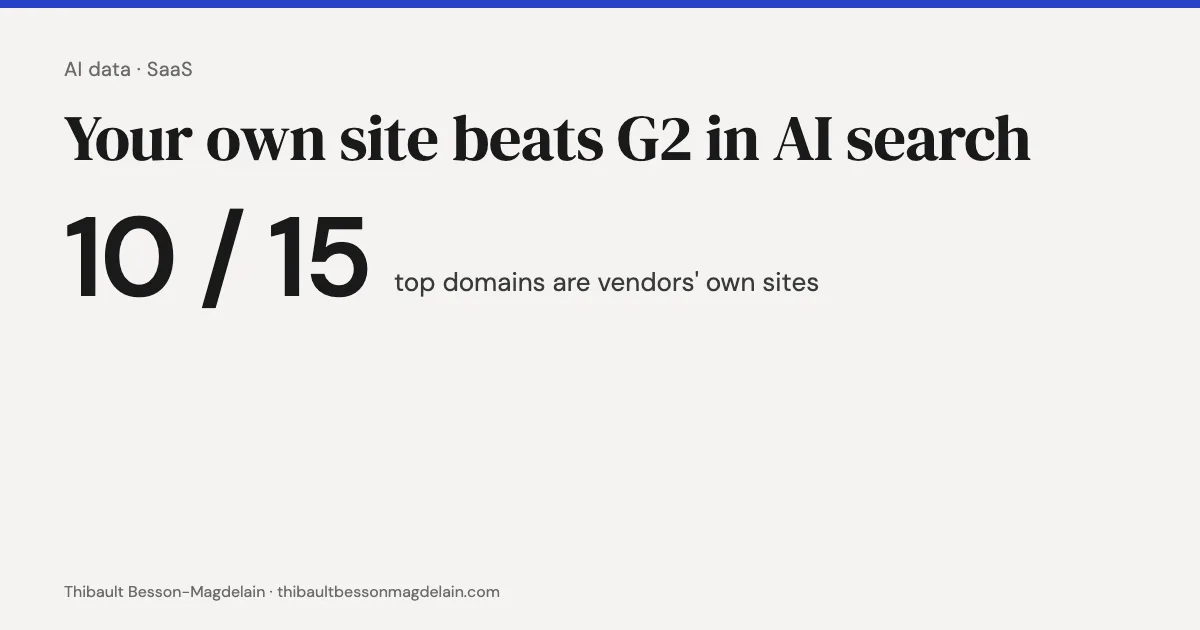
Shopify is the most cited domain, with 9.07 citations per 100 answers, followed by woocommerce.com (2.39), GitHub (2.37), the French data protection authority cnil.fr (2.28) and Salesforce (2.23). Ten of the 15 most cited domains are software vendors' own websites. G2, the first review site, ranks 15th with 1.22.
This is the opposite of what I see in most other industries. For lawyers, restaurants or builders, the AI quotes what third parties say: directories, review platforms, government sites. For software, it quotes the vendor. My reading: software buyers ask "can it do X", and only the vendor's documentation answers that with authority. The other third parties in the top 15 confirm the pattern: GitHub (code and documentation), the App Store (product listings), and a regulator, cnil.fr, cited when a question touches personal data and the GDPR.
Do G2 and Capterra matter for AI search?
Less than the marketing guides claim. G2 gets 1.22 citations per 100 answers on software questions, and Capterra does not appear in any of the lists (top 50 overall, top 30 for each AI). Review sites support a recommendation, mainly in French answers and with Gemini, but they are not what carries it.
| Review or comparison site | All AIs | Where it shows up most |
|---|---|---|
| g2.com | 1.22 | Gemini 1.82, Perplexity 0.87, ChatGPT 0.86 |
| Trustpilot | 0.81 | ChatGPT 1.22 |
| appvizer.fr | 0.45 | Perplexity 1.05 (Grok 3.29, 425 answers, indicative) |
| 0.45 | Perplexity 1.31 | |
| tool-advisor.fr | 0.37 | Perplexity 1.10 |
| lafabriquedunet.fr | not in top 50 | Claude 3.21, Perplexity 2.11 |
| getapp.com | not in top 50 | Claude 1.54 |
| capterra.com | not listed | Absent from every list |
Should you stop collecting reviews? No. Reviews are proof, and a buyer who reads an AI answer will often check G2 before booking a demo. But if your whole AI visibility plan is "get 50 reviews on G2", you are working on a source that weighs about one seventh of Shopify's own site in this panel. The bigger lever is elsewhere.
Does each AI read the same pages about software?
No. Gemini cites Shopify 13.54 times per 100 answers, Perplexity only 3.14 times. Beyond the leader, each AI has its own habits, and the gap decides which kind of page you should invest in.
- ChatGPT mixes vendor sites with official sources: cnil.fr (5.43), service-public.gouv.fr (2.88), the French cybersecurity agency cyber.gouv.fr (2.35), plus Microsoft's documentation (2.75) and shopify.dev (2.75). It likes pages that state rules.
- Gemini is the most vendor-centric: Shopify (13.54), sage.com (4.38), adobe.com (4.09), Salesforce (3.39). It is also the AI that cites G2 most (1.82).
- Perplexity is the only one to cite YouTube (3.16) and Reddit (1.31) regularly, along with French comparison sites like tool-advisor.fr and appvizer.fr. Video demos and community threads matter there.
- Claude cites the App Store (apple.com, 5.71) first, then Shopify (3.86), woocommerce.com (3.25) and the comparison blog lafabriquedunet.fr (3.21). Product listings and editorial comparisons count.
- Grok has 425 answers in this industry, so its figures are indicative only. Its list is dominated by WordPress (59.29) and woocommerce.com (32.71).
My opinion: if you sell to developers or e-commerce teams, documentation and integrations pages are worth more than any review campaign. If you sell to small French businesses, comparison sites and regulatory pages (GDPR, electronic invoicing) deserve a place in your plan, because ChatGPT and Perplexity read them.
Is it different in English?
Yes. In the 9,483 English-language software answers, review sites weigh even less: G2 drops to 0.63 citations per 100 answers, against 1.64 in French. The English top 5 is woocommerce.com (6.40), WordPress (5.10), GitHub (4.75), adobe.com (3.87) and Amazon (2.82): documentation and platforms first.
In French (17,185 answers), Shopify leads with 13.23, followed by cnil.fr (3.53) and sage.com (3.30). French answers lean more on regulators and local vendors (Pennylane, Qonto, Indy, Axonaut), which matches what I see across all industries: French-language AI answers cite official sources more. If you sell in both markets, plan the sources separately.
How do you get your SaaS recommended by AI?
You get recommended by publishing clear, specific, public pages about what your product does, keeping them consistent everywhere, and being present on the few third-party sources each AI reads in your category. Here is the order I follow for my own product.
- One page per use case and per buyer. "Invoicing software for freelancers in France" deserves its own page, with the answer in the first two sentences. An AI cannot recommend you for a need you never describe.
- Public, readable documentation. Help center and API docs open to crawlers, in HTML text. Shopify, Microsoft and GitHub are cited because their docs answer questions precisely.
- A public pricing page. Buyers ask "how much does X cost". A price in text is quotable; "contact sales" is not.
- Integration and comparison pages that stay honest. "X vs Y" pages that admit where the other tool is better are more credible to readers and to models.
- App store and marketplace listings. Claude cites the App Store more than any other site in this category.
- Then the review and comparison sites that actually show up in your category: G2 for Gemini, French comparison sites for Perplexity and Claude.
- Keep the SEO basics. Google is clear about its own AI features: "There are no additional requirements to appear in AI Overviews or AI Mode, nor other special optimizations necessary" (Google Search Central). Indexable, fast, well-linked pages come first.
Why do specific facts work? The Princeton team that coined generative engine optimization measured that adding statistics, quotations and sources to a page can raise its visibility in AI answers by up to 40% (Aggarwal et al., KDD 2024). Vague claims like "the leading all-in-one platform" give a model nothing to quote. I go deeper on the classic side in my guide to SaaS SEO and on the AI side in how to rank in ChatGPT.
How do you measure your SaaS visibility in AI?
You measure it by asking the AIs your buyers' real questions every month and recording two things: which products are named, and which pages are cited. Your share of the names is your visibility; the cited pages are your to-do list.
- List 20 buyer questions across your category, use cases and competitors: "best X for Y", "X alternatives", "is X GDPR compliant".
- Ask the five AIs with web search on, in fresh sessions.
- Record the products named and their order, then the domains cited.
- Watch the trend, not one test. In this panel, YouTube went from 4.76 citations per 100 answers in July 2026 to 0.26 in October, and Reddit from 2.19 to 0.22. Sources move fast.
By hand, this is a spreadsheet and a few hours a month. To run it weekly across five AIs, I use Sorank's AI mention tracking, and the Sorank page for SaaS companies explains the setup for a software product (plans on the pricing page). If you want to know why I am skeptical of Reddit-first strategies, read how much AI really cites Reddit, and for all industries, which sources AI cites.
What are the limits of this data?
- A panel, not the whole market. The questions are those tracked for Sorank clients and their competitors: e-commerce, accounting, property management, field service, e-signature, and more. Shopify's lead partly reflects how many e-commerce questions the panel holds.
- Period. Industry classification starts in July 2026: four months of data.
- Samples by AI. ChatGPT and Gemini 8,606 answers each, Perplexity 6,106, Claude 2,925, Grok 425 (indicative).
- Unit. Citations per 100 answers, not a share of answers.
- No self-promotion. Answers about sorank.com itself are excluded from the dataset.
So, how does AI search work for SaaS?
For software, AI search cites the vendors' own websites and documentation far more than review sites: 10 of the 15 most cited domains are vendor sites, G2 gets 1.22 citations per 100 answers and Capterra does not appear. Each AI then adds its own layer: regulators for ChatGPT, YouTube and Reddit for Perplexity, the App Store and comparison blogs for Claude. Publish specific, public pages for each use case, keep reviews as proof, and measure every month.
To see which products the five AIs recommend in your category right now, and which pages they quote, start tracking your AI mentions with Sorank.
Sources
- Sorank Data, AI citation study: software, snapshot of 2 November 2026: every software figure in this article.
- Gartner, press release of 20 May 2026: 45% of B2B buyers used generative AI during a recent purchase.
- Google Search Central, "AI features and your website": no special optimization required for AI Overviews and AI Mode.
- Aggarwal et al., "GEO: Generative Engine Optimization", KDD 2024: up to 40% visibility gain.
- Pew Research Center, 25 June 2025: 34% of US adults have used ChatGPT.
FAQ
Does ChatGPT use G2 reviews to recommend software?
Sometimes, but not much. In this dataset ChatGPT cites g2.com 0.86 times per 100 software answers, less than Trustpilot (1.22) and far less than vendor sites like Shopify (10.99) or official pages like cnil.fr (5.43). Reviews help, but ChatGPT relies first on pages that describe the product precisely.
How do I get my SaaS mentioned by AI?
Publish one clear page per use case and buyer type, open your documentation and pricing to crawlers, list your product on the app stores and marketplaces of your ecosystem, and keep facts consistent across sites. Then check every month which products and pages the AIs cite for your buyers' questions.
Which AI cites review sites the most for software?
Gemini, with 1.82 citations per 100 answers for G2. Perplexity cites French comparison sites (tool-advisor.fr 1.10, appvizer.fr 1.05) and Reddit (1.31), while Claude cites lafabriquedunet.fr (3.21) and GetApp (1.54). Capterra does not appear in any AI's top 30.
Founder of Sorank, the SEO and GEO platform that tracks how ChatGPT, Gemini, Perplexity, Claude and Grok talk about brands. Before Sorank, I ran an SEO agency that served more than 100 clients. Based in Budapest.
Read next
-
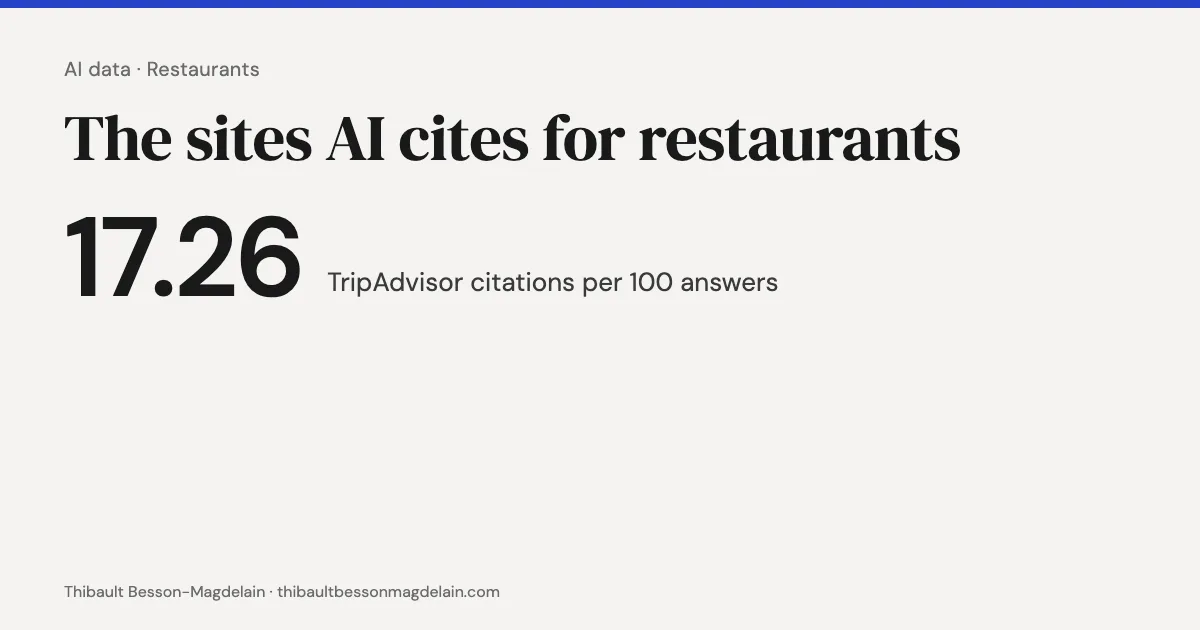
AI Search for Restaurants: Which Sites Get You Recommended
Which sites ChatGPT, Gemini, Claude and Perplexity cite for restaurants: TripAdvisor leads, Gemini prefers guides.
-
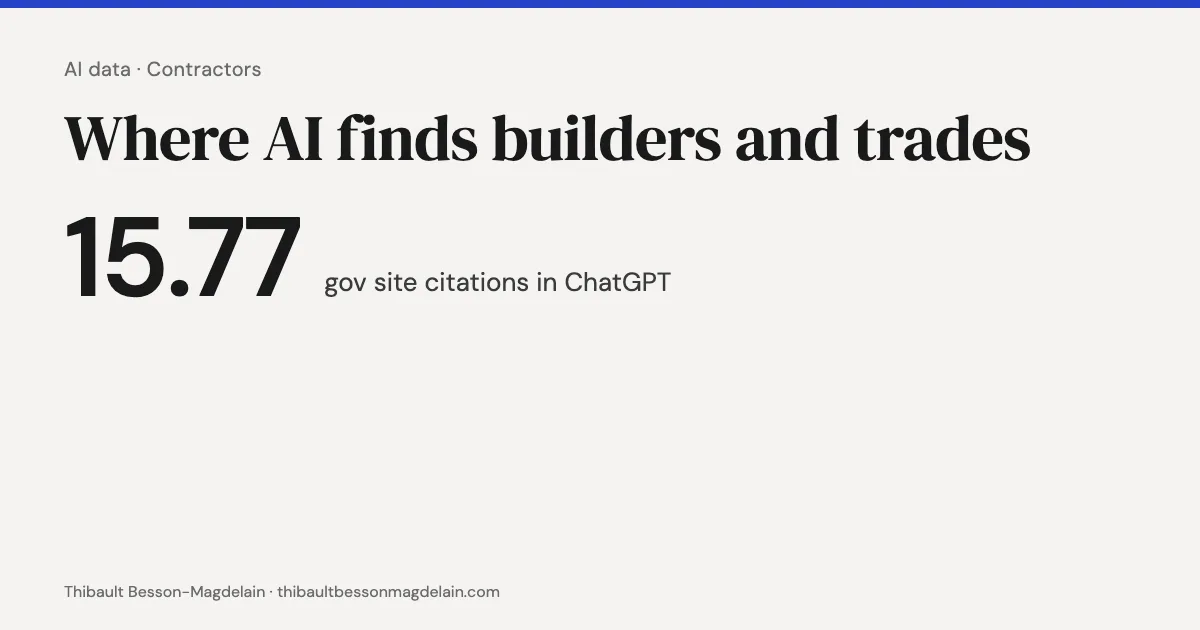
AI Search for Contractors: Where AI Finds Builders and Trades
To recommend contractors, ChatGPT cites government sites while Gemini and Claude rely on business directories.
-
AI Search in Real Estate: Which Sources AIs Cite, and Who They Recommend
On 14,855 real estate questions, AIs cite government sites and PagesJaunes far more than property portals.
Continue on AI visibility: all articles on the blog