AI Search in Finance and Insurance: Regulators Come First
Money questions are where AI is most careful, and where the models disagree the most. I analyzed 8,575 AI answers about finance and insurance providers. ChatGPT builds its answers on regulators; Gemini, Claude and Perplexity build them on comparison sites, brokers and firms' own pages.

Published · Updated · 10 min read
Contents
- How does AI search answer finance questions?
- Which sources does AI cite for finance?
- Which sources does AI cite for insurance?
- Do all AIs trust the same financial sources?
- Why are regulators so present in AI answers?
- How do you get a financial firm recommended by AI?
- What about English-language answers?
- What are the limits of this data?
- FAQ
AI search in finance follows its own rules. When someone asks "which accountant for a small company in Brussels" or "best health insurance for an expat in Switzerland", the AI does not just name firms: it first checks who is allowed to do what. That matters at scale, because AI is now a mainstream tool: 34% of US adults had used ChatGPT by early 2025, according to Pew Research Center, and in France 48% of people use generative AI, according to the telecom regulator Arcep.
I build Sorank, a platform that asks the same client questions to ChatGPT, Gemini, Perplexity, Claude and Grok every week. Its public studies on AI citations in finance and AI citations in insurance hold 5,475 and 3,100 answers, collected between July and October 2026. All the figures below come from the snapshot of 2 November 2026. Nothing here is financial advice: it is about who gets cited, not where to put your money.
How does AI search answer finance questions?
On finance and insurance, AI answers in two layers: an official layer (regulators, central banks, ministries, registers) that sets the rules and the warnings, and a market layer (comparison sites, brokers, firms) that names the options. Which layer dominates depends heavily on the AI: ChatGPT stays in the official layer, the others move quickly to the market.
The models are also more economical with links here. A finance answer carries on average 3.36 citations with ChatGPT, 3.18 with Claude, 1.75 with Perplexity and 7.72 with Gemini. Insurance answers are similar. Few links means few winners: being one of the two or three sources an AI trusts in your niche is worth a lot.
Which sources does AI cite for finance?
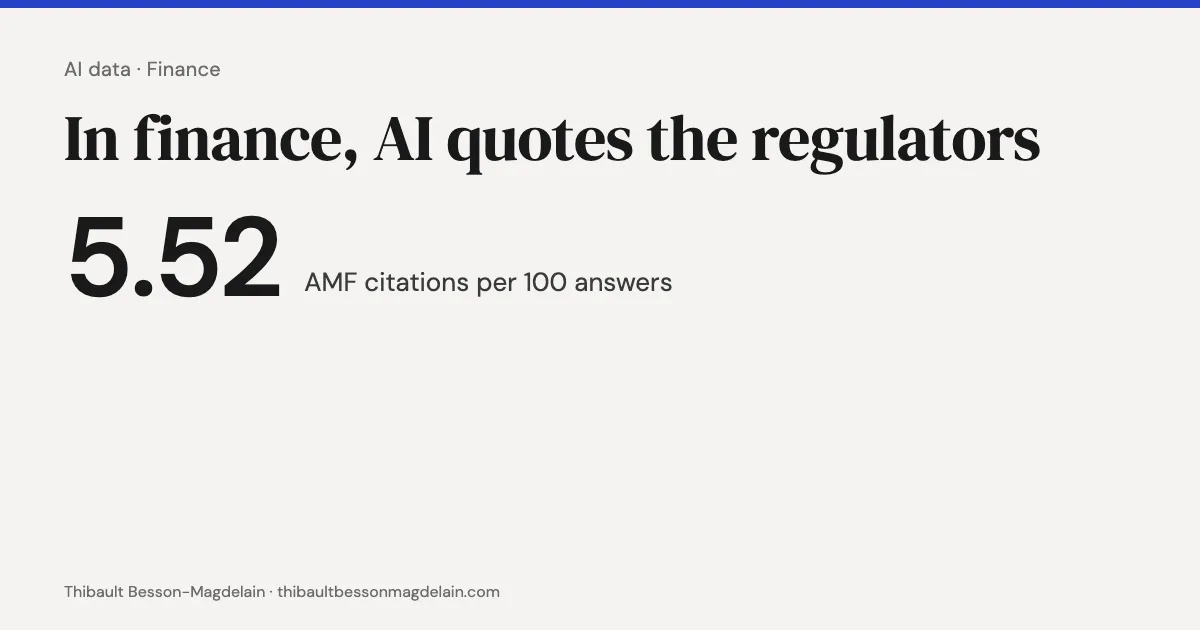
The French financial markets authority, the AMF, is the most cited site on finance questions, with 5.52 citations per 100 answers. Then come a Belgian accounting firm (myfid.be, 5.11), the Belgian institute of tax advisors and accountants (itaa.be, 4.84), the Banque de France (3.78) and the European Energy Exchange (eex.com, 3.34). Four of the ten most cited domains are regulators or public bodies.
The rest of the top 20 is a mix that reflects the questions in the panel: accounting firms in Belgium, Swiss pension bodies, carbon and energy exchanges, treasury software (Kyriba, Defacto), and the French register of insurance and finance intermediaries, ORIAS (1.72). Big consumer platforms are nearly absent: Trustpilot stays under 1 citation per 100 answers every month in finance (0.70 in October 2026), and Reddit gets at most 1.00 citation per 100 answers in a single month.
Which sources does AI cite for insurance?
On insurance, the leader is a comparison site: yago.be, with 12.42 citations per 100 answers, ahead of the Belgian financial regulator FSMA (5.90), AXA Belgium (5.45), the broker DAP (4.97) and Bupa UK (4.74). The Swiss regulator FINMA (4.23) and the Swiss Federal Office of Public Health (4.03) follow. Insurance answers lean more on comparison sites and brokers than finance answers do.
| Type of source | Finance (examples) | Insurance (examples) |
|---|---|---|
| Regulator or public body | amf-france.org 5.52, banque-france.fr 3.78, economie.gouv.fr 2.50 | fsma.be 5.90, finma.ch 4.23, bag.admin.ch 4.03 |
| Professional register or body | itaa.be 4.84, orias.fr 1.72 | biba.org.uk 1.71 |
| Comparison site or broker | (few) | yago.be 12.42, lelynx.fr 3.55, comparis.ch 2.94, lesfurets.com 2.61 |
| Firm's own website | myfid.be 5.11, ubs.com 2.74 | axa.be 5.45, dap.be 4.97, bupa.co.uk 4.74 |
| Review platform | Trustpilot: under 1 every month | Trustpilot 1.48 |
Do all AIs trust the same financial sources?
No, and finance is where the split is sharpest. ChatGPT's five most cited sources are public bodies in both industries. In finance: Banque de France (11.18), AMF (10.14), ITAA (7.45), the French economy ministry (6.74) and its Belgian counterpart (4.05). In insurance: the Swiss Federal Office of Public Health (13.11), FSMA (11.11), the UK government-backed MoneyHelper service (10.22), the FCA (10.00) and FINMA (9.67).
- ChatGPT answers like a cautious advisor: rules, registers, warnings, then a few names. It cites the comparison site Yago only 1.44 times per 100 insurance answers.
- Gemini combines both layers: ITAA (8.16) and FSMA (5.78) on the official side, myfid.be (8.71), Yago (15.00) and Comparis (13.00) on the market side. It cites the most links per answer.
- Claude goes to the market: myfid.be (7.17), the accounting network Amarris (5.17) and PagesJaunes (4.67) in finance; Yago (22.00) and Belgian brokers in insurance.
- Perplexity favors comparison sites in insurance (lelynx.fr 6.86, lecomparateurassurance.com 5.14, meilleurtaux.com 4.43) and accounting firms in finance.
- Grok has no finance answers and only 200 insurance answers, dominated by Yago (59.50). Indicative only.
My take: for a financial firm, there are two jobs. Being correctly registered and findable in the official registers is what lets ChatGPT name you without hesitation. Being present on the comparison sites and in the directories of your market is what gets you into Gemini, Claude and Perplexity. Most firms only do one of the two.
Why are regulators so present in AI answers?
Because money is a "Your Money or Your Life" topic, where a wrong answer causes real harm, and regulators are the sources that can be trusted by default. Google's own guidance says its systems give extra weight to trust "for topics that could significantly impact the health, financial stability, or safety of people" (Google Search Central). AI models show the same caution, ChatGPT most of all.
Regulators also publish exactly what a careful answer needs: who is authorized, which firms are blacklisted, what consumers should check. The UK Financial Conduct Authority puts it simply on its register page:
"You should check the details of any individual carrying out regulated activities on your behalf."Financial Conduct Authority, Financial Services Register
When an AI tells a user to check the register, it is doing what the regulator asks. If your firm is listed correctly, with the same name and details as on your website, that check works in your favor. If your trading name differs from your registered name and nothing links the two, it works against you.
How do you get a financial firm recommended by AI?
You get recommended by being verifiable in the official registers, present on the comparison sites and directories of your market, and clear on your own pages about what you are authorized to do, for whom and at what cost. Here is the order I would follow.
- Check your registrations. Your entry in the relevant register (FCA, AMF, ORIAS, FSMA, FINMA, ITAA) must match your website: legal name, trading name, address, registration number. Show the number on your site, with a link to the register.
- Explain the rules on your pages. Which regulated activities you perform, which you do not, what protection the client has. ChatGPT's answers are built on that vocabulary.
- Be listed on the comparison sites that matter. In insurance, Yago, Le Lynx, Comparis, LesFurets and the like are the main market sources for Gemini, Claude and Perplexity.
- Complete your directory profiles. Claude cites PagesJaunes 4.67 times per 100 finance answers; accounting and advisory firms are often found that way.
- One page per service and client type. "Accounting for freelancers in Liège", "health insurance for cross-border workers": the AI needs a page that answers the exact question.
- Facts, sources, no promises. The Princeton researchers who named generative engine optimization showed that adding statistics and citations of reliable sources can raise a page's visibility in AI answers by up to 40% (Aggarwal et al., KDD 2024). In finance, it is also what your compliance team will ask for.
The Sorank page for financial advisors shows how the tracking works for a firm (plans on the pricing page). To understand why ChatGPT behaves so differently, read what sources ChatGPT uses; for the language effect, AI answers in French vs English; and for the cross-industry view, which sources AI cites.
What about English-language answers?
The English samples are smaller and topic-specific. In finance (1,200 answers), they are dominated by energy and carbon exchanges (eex.com 15.25, ice.com 11.83) and proprietary trading firms (topstep.com 10.83). In insurance (1,275 answers), UK health insurers and UK public bodies lead: Bupa (11.53), Aviva (9.33), Vitality (9.25), MoneyHelper (8.71), then the FCA (5.65) and the Financial Ombudsman Service (5.10).
The two-layer pattern holds in English too: official guidance and the regulator first, then the firms. If you operate in the UK, the FCA register and MoneyHelper play the role that the AMF and ORIAS play in France.
What are the limits of this data?
- Topic mix. The questions are those tracked for Sorank clients: accounting and tax advice in Belgium, Swiss pensions, treasury software, energy markets, health and car insurance. Leaders like myfid.be or eex.com come from that mix.
- Geography. Finance: 4,275 answers in French, 1,200 in English. Insurance: 1,825 in French, 1,275 in English. Belgium and Switzerland weigh a lot.
- Samples by AI. Finance: ChatGPT and Gemini 1,825 each, Perplexity 1,225, Claude 600, no Grok. Insurance: ChatGPT and Gemini 900, Perplexity 700, Claude 400, Grok 200 (indicative).
- Period and unit. July to October 2026; citations per 100 answers, not a share of answers.
So, how does AI search work in finance?
In finance and insurance, AI search checks the rules before naming firms: the AMF is the most cited finance source (5.52 citations per 100 answers) and ChatGPT's five favorite sources are public bodies, while Gemini, Claude and Perplexity lean on comparison sites, brokers and firms (Yago gets 22.00 with Claude). Review platforms barely count. A firm that is correctly registered, present on the comparison sites of its market and clear on its own pages covers both layers.
To see what the five AIs say about your financial market today, start tracking your AI mentions with Sorank.
Sources
- Sorank Data, AI citation study: finance, snapshot of 2 November 2026: every finance figure.
- Sorank Data, AI citation study: insurance, snapshot of 2 November 2026: every insurance figure.
- Financial Conduct Authority, Financial Services Register: why consumers should check a firm.
- Google Search Central, "Creating helpful, reliable, people-first content": trust and YMYL topics.
- Aggarwal et al., "GEO: Generative Engine Optimization", KDD 2024: up to 40% visibility gain.
- Pew Research Center, 25 June 2025: 34% of US adults have used ChatGPT.
- Arcep, digital barometer, February 2026: 48% of people in France use generative AI.
FAQ
Which sources does ChatGPT use for financial questions?
Mostly public bodies. In this dataset, ChatGPT's most cited finance sources are the Banque de France (11.18 citations per 100 answers), the AMF (10.14), the Belgian tax advisors' institute ITAA (7.45) and the French economy ministry (6.74). In insurance, it cites the Swiss health office, the Belgian regulator FSMA, MoneyHelper, the FCA and FINMA.
How can a financial advisor get recommended by AI?
Make sure your entry in the official register matches your website, show your registration number with a link, explain on your pages which regulated services you offer, and be present on the comparison sites and directories of your market. ChatGPT checks the official layer; Gemini, Claude and Perplexity rely more on the market layer.
Do reviews help a financial firm in AI search?
Very little as a cited source: Trustpilot gets 1.48 citations per 100 insurance answers and stays under 1 every month in finance. Reviews can still influence comparison sites and directories, which the AIs do cite, so they help indirectly.
Founder of Sorank, the SEO and GEO platform that tracks how ChatGPT, Gemini, Perplexity, Claude and Grok talk about brands. Before Sorank, I ran an SEO agency that served more than 100 clients. Based in Budapest.
Read next
-
AI Search in Healthcare: Which Sources AI Trusts for Care
In healthcare, AI cites public health authorities first, then care providers' own sites: 13 of the 20 most cited domains.
-
AI Search for Contractors: Where AI Finds Builders and Trades
To recommend contractors, ChatGPT cites government sites while Gemini and Claude rely on business directories.
-
AI Search for SaaS: Your Own Website Beats G2
Across 26,668 AI answers about software, vendors' own sites are cited far more than G2, and Capterra is absent.
Continue on AI visibility: all articles on the blog